The percentage of kindergarten students with vaccine exemptions reached an all-time high in Arkansas and across the nation in the 2024-25 school year, according to the Centers for Disease Control and Prevention (CDC).
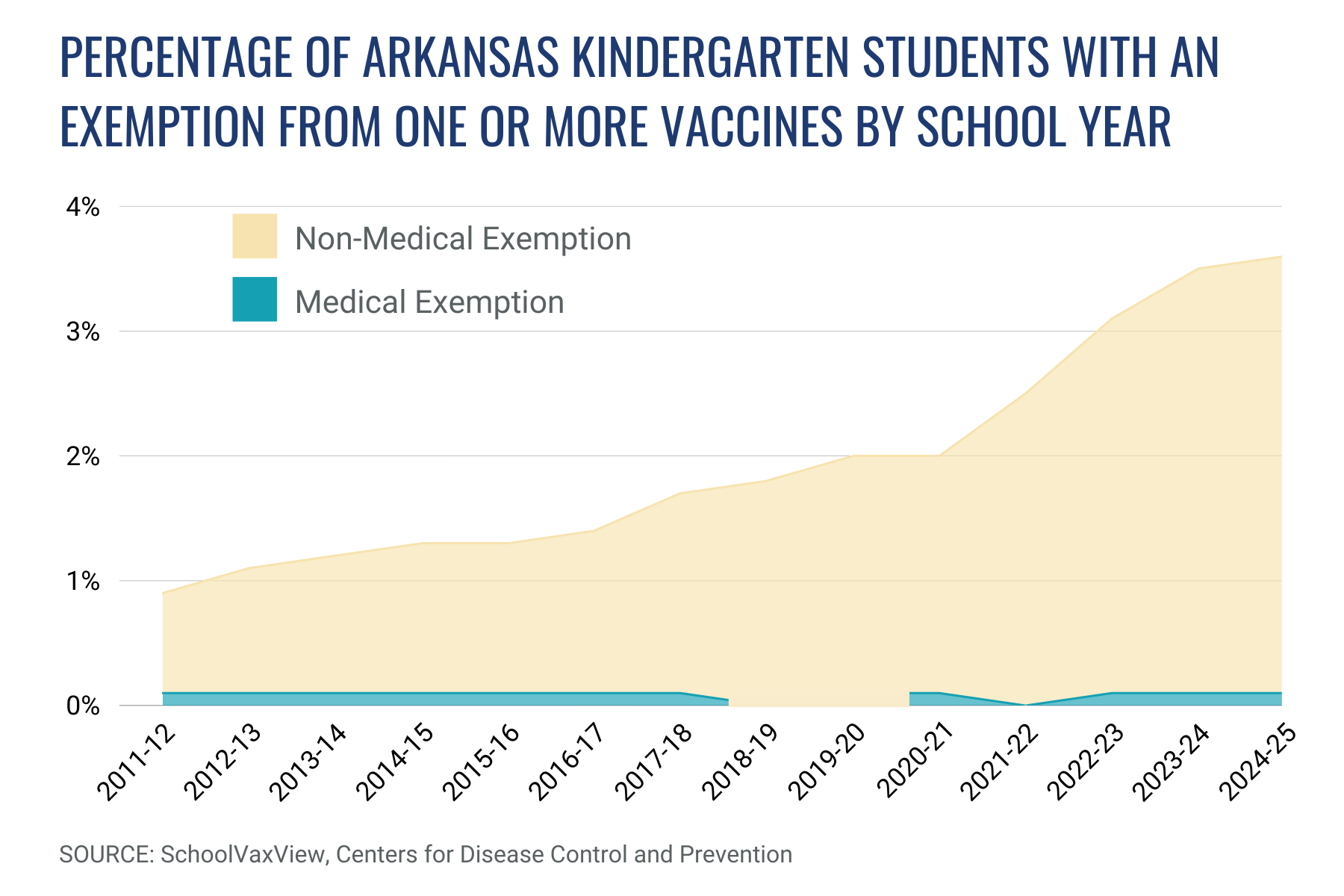
Most states allow children to be exempted from vaccines for medical or non-medical reasons; the latter may be allowed for either religious or philosophical reasons — or, in the case of Arkansas and 13 other states, both. CDC data show that for the 2024-25 school year, 3.5% of Arkansas kindergarten students had non-medical vaccine exemptions and 0.1% had medical exemptions. This was a slight increase from the 2023-24 school year, when 3.4% of Arkansas kindergarten students had non-medical vaccine exemptions and 0.1% had medical exemptions.
Arkansas’s rate of exemptions has risen every year since the 2015-16 school year, when 1.2% of kindergarten students had non-medical exemptions and 0.1% had medical exemptions. In 2016 and 2017, Arkansas experienced a mumps outbreak with nearly 3,000 cases. During the outbreak, the Arkansas Department of Health required students who were not fully vaccinated because of exemptions to be excluded from school for 26 days if they were exposed to the virus.
The national rate of childhood vaccine exemptions also reached an all-time high in the 2024-25 school year. The CDC reported that 3.4% of U.S. kindergarten students had non-medical vaccine exemptions and 0.2% had medical exemptions for 2024-25. This was up from the previous school year, when 3.1% of U.S. kindergarten students had non-medical exemptions and 0.2% had medical exemptions.
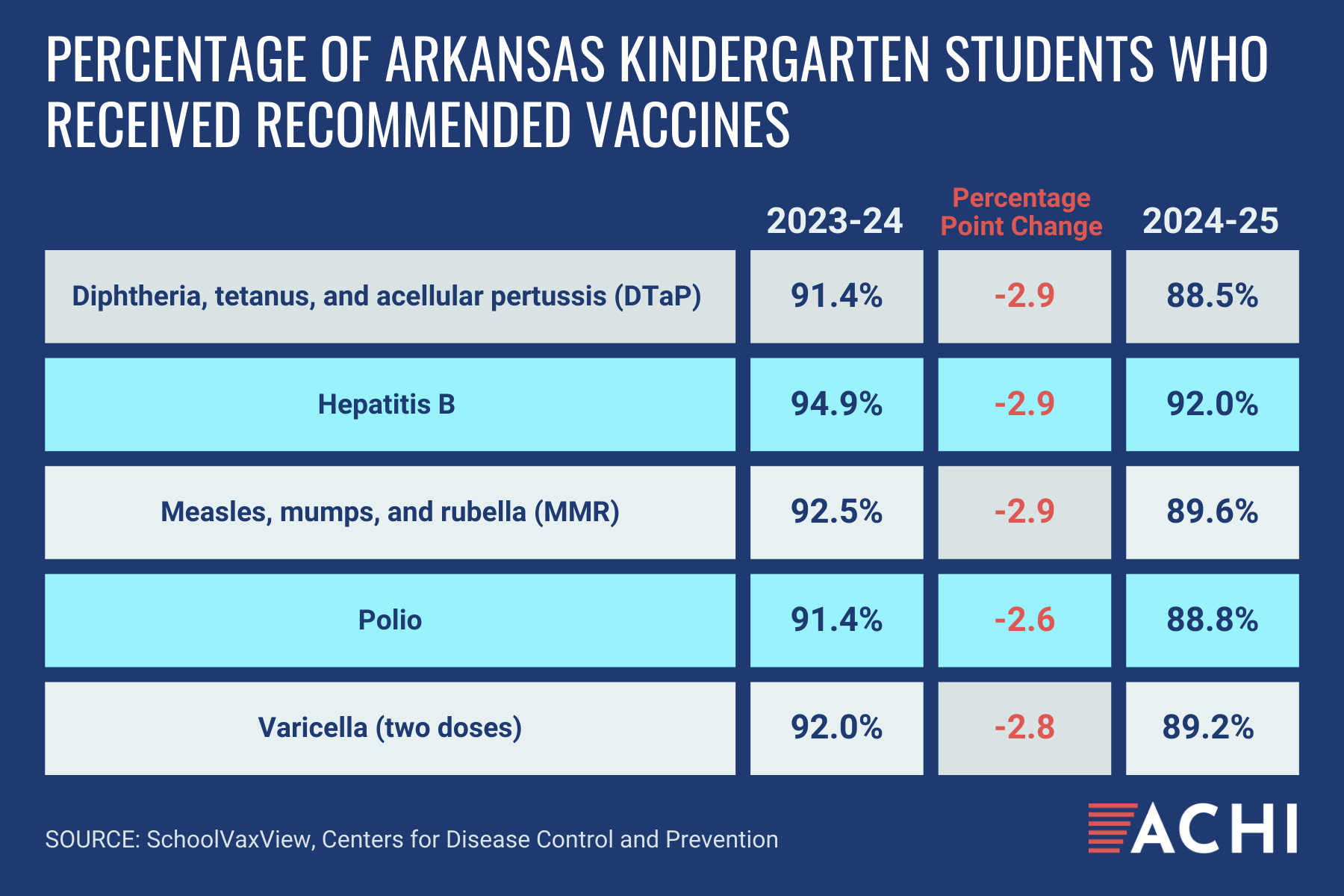
The findings are based on data submitted by states to the CDC. The agency also reported that vaccine coverage among Arkansas kindergarten students decreased in the 2024-25 school year for all reported vaccines. Nationwide, coverage among kindergarten students increased slightly for hepatitis B, going from 93.9% in the 2023-24 school year to 94% in the 2024-25 school year, but decreased for diphtheria, tetanus, and acellular pertussis (dTaP); measles, mumps, and rubella (MMR); polio; and a two-dose regimen of the varicella vaccine.
Other findings include:
During the 2024-25 school year, 3.6% of U.S. kindergarten students were exempt from one or more vaccines, up form 3.3% the year before.
Exemptions for the 2024-25 school year increased in 36 states and the District of Columbia, with 17 states reporting exemptions exceeding 5%.
The number of U.S. kindergarten students exempt from one or more vaccines was about 138,000 during the 2024-25 school year, up from 127,000 the year before.
Coverage with the MMR, DTaP, polio, and varicella vaccines decreased in more than half of states in the 2024-25 school year, compared with coverage the year before.
The number of U.S. kindergarten students attending school without documentation of completing the MMR vaccine series was about 286,000 during the 2024-25 school year, up from 280,000 the year before.
The above-named vaccines are recommended for children early in life to build immunity and protect them prior to contact with life-threatening diseases, which they can be more susceptible to at a young age. When a large enough percentage of a population is vaccinated against a disease, those who are not vaccinated can still be protected by herd immunity, also known as community immunity. Herd immunity exists when enough people are immune to an infectious disease to limit the disease’s ability to spread.
According to the World Health Organization, the percentage of people who need to be vaccinated or immune to a disease to achieve herd immunity varies, ranging from about 80% for polio to more than 95% for measles.