Arkansas continues to have one of the nation’s highest lung cancer incidence rates, according to a new report from the American Lung Association.
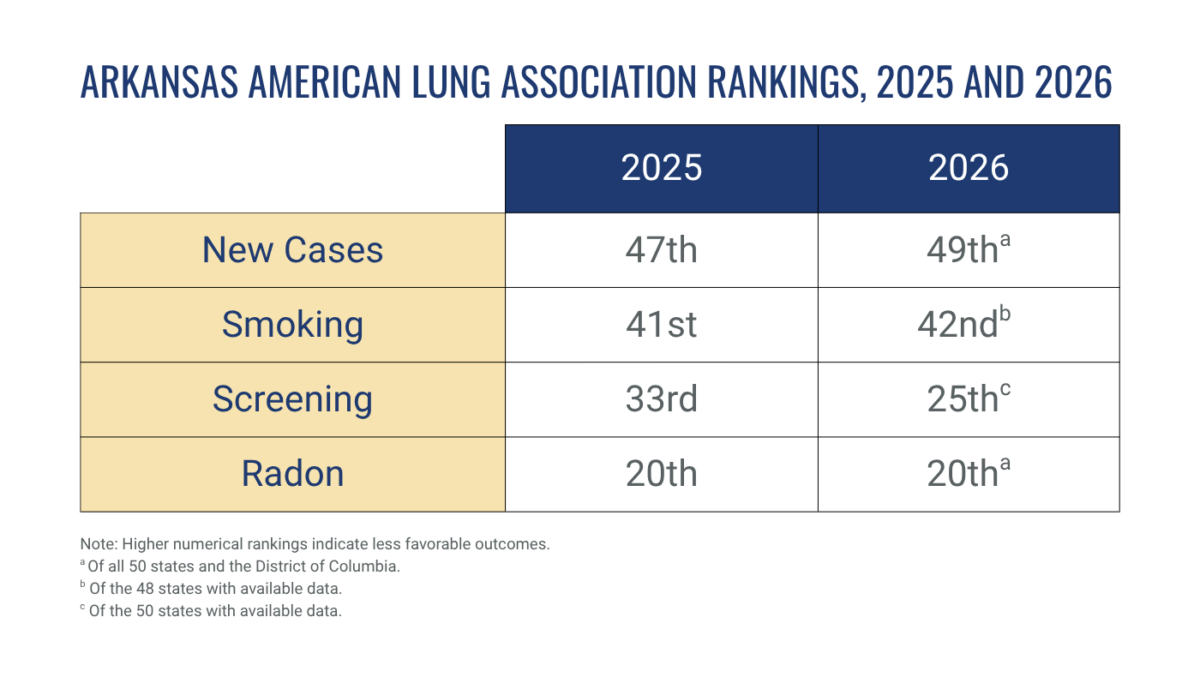
The 2026 “State of Lung Cancer” report finds that based on data for 2018 through 2022, the rate of new lung cancer cases in Arkansas was 70.4 cases per 100,000 residents. The report ranks Arkansas’s incidence rate 49th out of the 50 states and the District of Columbia, with the top-ranked state, Utah, having the lowest rate and the bottom-ranked state, Kentucky, having the highest rate. In the 2025 installment of the report, Arkansas ranked 47th with a rate of 68.2 new cases per 100,000 residents, based on data from 2017 through 2021.
National Indicators Show Improvement
Lung cancer is the leading cause of cancer-related deaths in the U.S. — resulting in about 340 deaths a day nationally and 2,000 deaths a year in Arkansas. Though lung cancer remains a pervasive public health issue, the “State of Lung Cancer” report indicates that several national indicators have improved over the past five years:
- The national lung cancer incidence rate was 52.1 cases per 100,000 people, an 11% decrease over the past five years. National incidence rates were determined from 2019-2023 data.
- 29.3% of people with lung cancer were diagnosed before their cancer spread, an 18% increase over the past five years. Diagnosis rates were determined from 2019-2023 data.
- The percentage of people living five years after being diagnosed with lung cancer was 31.0%. That represents a 24% increase over the past five years. Survival rates were determined from 2016-2022 data.
Arkansas Lung Cancer Indicators
Tobacco use is the leading cause of lung cancer. According to 2025 data, 14.2% of Arkansas adults smoke tobacco, compared to 10.2% nationally. The report ranks Arkansas at 42nd of the 48 states with available data, with higher numerical rankings indicating less favorable outcomes.
In other indicators, Arkansas reported rates that were statistically similar to national averages. The lung cancer screening rate among individuals at high risk in Arkansas was 24.3% in 2024, close to the national rate of 24.4%. The report ranks Arkansas at 25th of the 50 states with available data.
Among tests in Arkansas for radon, a colorless, odorless gas that is the second leading cause of lung cancer, 20.1% detected levels above the Environmental Protection Agency’s recommended levels. The report ranks Arkansas 20th among all states. Radon indicators were determined using 2008-2017 data weighted with 2019 data.
Arkansas data are not available for many indicators, including survival rate, early diagnosis, surgical treatment, and lack of treatment. This prevents comparison between state and national indicators in these areas.
Lung Cancer Trends in Arkansas
Arkansas rankings changed across several indicators between the 2025 and 2026 reports. The state’s ranking for screenings among high-risk individuals improved slightly, while its rankings for new lung cancer cases and smoking worsened. The radon ranking was unchanged.
Arkansas Policy Developments
Arkansas has made efforts to improve lung cancer prevention. Act 390 of 2025 requires health plans offered in Arkansas to provide coverage for lung cancer screenings and follow-up healthcare services in alignment with American Cancer Society guidelines. Also, the University of Arkansas for Medical Sciences’ Winthrop P. Rockefeller Cancer Institute launched mobile lung cancer screening vans in October 2026, expanding screening access in high-need areas of the state.
Despite screening improvements, the American Lung Association grades Arkansas’s tobacco prevention efforts poorly. Arkansas Tobacco Prevention and Cessation program funding has fallen short of the Centers for Disease Control and Prevention’s (CDC) recommendations, which prevents the state from meeting other CDC best practices.
The association suggests that all states could do more to prevent lung cancer, such as improving screening rates among high-risk populations, addressing racial disparities that impact lung cancer outcomes, decreasing exposure to radon and secondhand smoke, and eliminating tobacco use.
More information about the methodology used in the “State of Lung Cancer” report is available here.
For more on lung cancer in Arkansas, and a discussion of promising new treatments, listen to our podcast episode featuring Dr. Matthew Steliga, a thoracic surgeon at the University of Arkansas for Medical Sciences and a member of the Tobacco Prevention and Cessation Advisory Committee for Arkansas.