Rural Health in Arkansas
There is a clear divide in terms of healthcare access between rural and urban parts of our state. This page serves to provide insight into the rural health landscape in Arkansas and efforts to improve care for rural communities.
Reports and Explainers
Rural Hospital Closures
Rural Healthcare Workforce
News and Updates
Arkansas is a largely rural state by any measure. More than one-third of Arkansans live in non-metropolitan areas, and rural communities often face additional healthcare challenges such as reduced access to care and shortages of healthcare professionals. In Arkansas, those challenges have been compounded by a significant demographic shift. In recent decades, rural Arkansas has experienced dramatic out-migration, particularly by younger populations. This continuing trend is leaving rural areas with older populations facing higher health-risk burdens and increased rates of chronic disease.
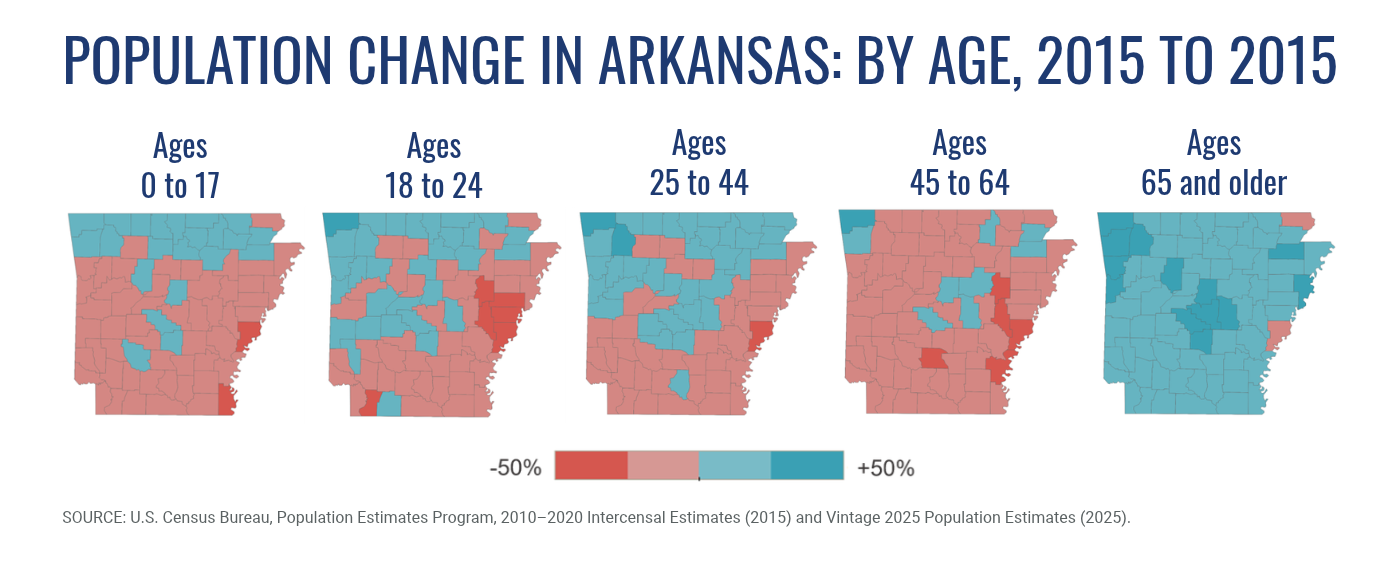
This demographic shift also leaves the state’s rural hospitals to care for older and sicker patients with fewer resources compared to urban hospitals. State and local leaders have worked to secure access to care for rural Arkansans, including recruitment of rural healthcare providers, a network of county health units, and other efforts. That work continues, in part, through a wave of innovative new and expanded programs funded by the federal Rural Health Transformation Program.
ARKANSAS RURAL HEALTH TRANSFORMATION PROGRAM
The Rural Health Transformation Program (RHTP) is a five-year, $50 billion federal initiative that makes annual awards to the states to strengthen rural health systems and address rural health issues. For year one, Arkansas received an award of $208.8 million, which the Arkansas Governor’s Office distributed to subgrantees across four strategic initiatives:
- THRIVE: Telehealth, Health-monitoring, and Response Innovation for Vital Expansion
- PACT: Promoting Access, Coordination, and Transformation
- HEART: Healthy Eating, Active Recreation, and Transformation
- RISE AR: Recruitment, Innovation, Skills, and Education for Arkansas
For information about the Rural Health Transformation Program and Arkansas’s application to the program, see our explainer. The dashboard below displays the year one award amounts by initiative, recipient, and funded project, and provides summary descriptions of projects from publicly available sources.
Related Reports and Explainers
RURAL HOSPITAL CLOSURES IN ARKANSAS AND SURROUNDING STATES
In addition to providing healthcare coverage to low-income, non-caretaker adults, the 2014 expansion of the Arkansas Medicaid program also resulted in reduced uncompensated care for hospitals across the state. The reduction in uncompensated care and associated increase in covered populations helped the Arkansas healthcare system avoid the rural hospital closings experienced in neighboring states.
Since 2012, no rural hospital in Arkansas has closed without being reopened or replaced with another hospital. De Queen Medical Center closed in in May 2019, but Sevier County is no longer without a rural hospital; Sevier County Medical Center opened in January 2023.
This map depicts only the closures of rural hospitals that have not reopened or been replaced since January 2012 in Arkansas and neighboring states. It is based on data from the Cecil G. Sheps Center for Health Services Research at the University of North Carolina at Chapel Hill.
RURAL HEALTHCARE WORKFORCE
Arkansas, like other states, faces a shortage of physicians, nurses, and other healthcare providers. Healthcare workforce shortages can become particularly acute for rural communities, which often face diminished access to care. In 2023, 77.4% of Arkansas’s primary care physicians practiced in urban counties and more than one-third of Arkansans lived in health professional shortage areas. As part of ACHI’s work to assess healthcare challenges facing rural communities, we have developed a series of interactive dashboards to examine the prevalence and activity of various healthcare providers at the state and county levels.
For more insight into the Arkansas healthcare workforce, visit our topic page.