Known as the Food Stamp Program until the name was changed to SNAP in 2008, the program was created in response to the Great Depression and existed as a pilot program from 1939 to 1943. Participants purchased orange stamps which equaled the amount they usually spent on food and received additional blue stamps that could be used only for USDA-designated surplus foods. Nearly two decades later, President John F. Kennedy expanded food distribution across the U.S. through executive order and announced that the USDA would reintroduce the Food Stamp Program on a pilot basis.5 The pilot program eliminated the two-color system and no longer required a portion of the stamps to be used for surplus foods.
SNAP also serves as an economic stimulus by providing a multiplier effect, meaning that every dollar spent on SNAP benefits leads to additional economic activity. During economic downturns, each dollar in SNAP benefits generates an estimated $1.50 to $1.80 in economic activity.6 A $1 billion increase in SNAP benefits can lead to a $1.54 billion rise in the country’s gross domestic product, support about 13,560 jobs, and contribute an additional $32 million to farm income.5
SNAP Participation in Arkansas
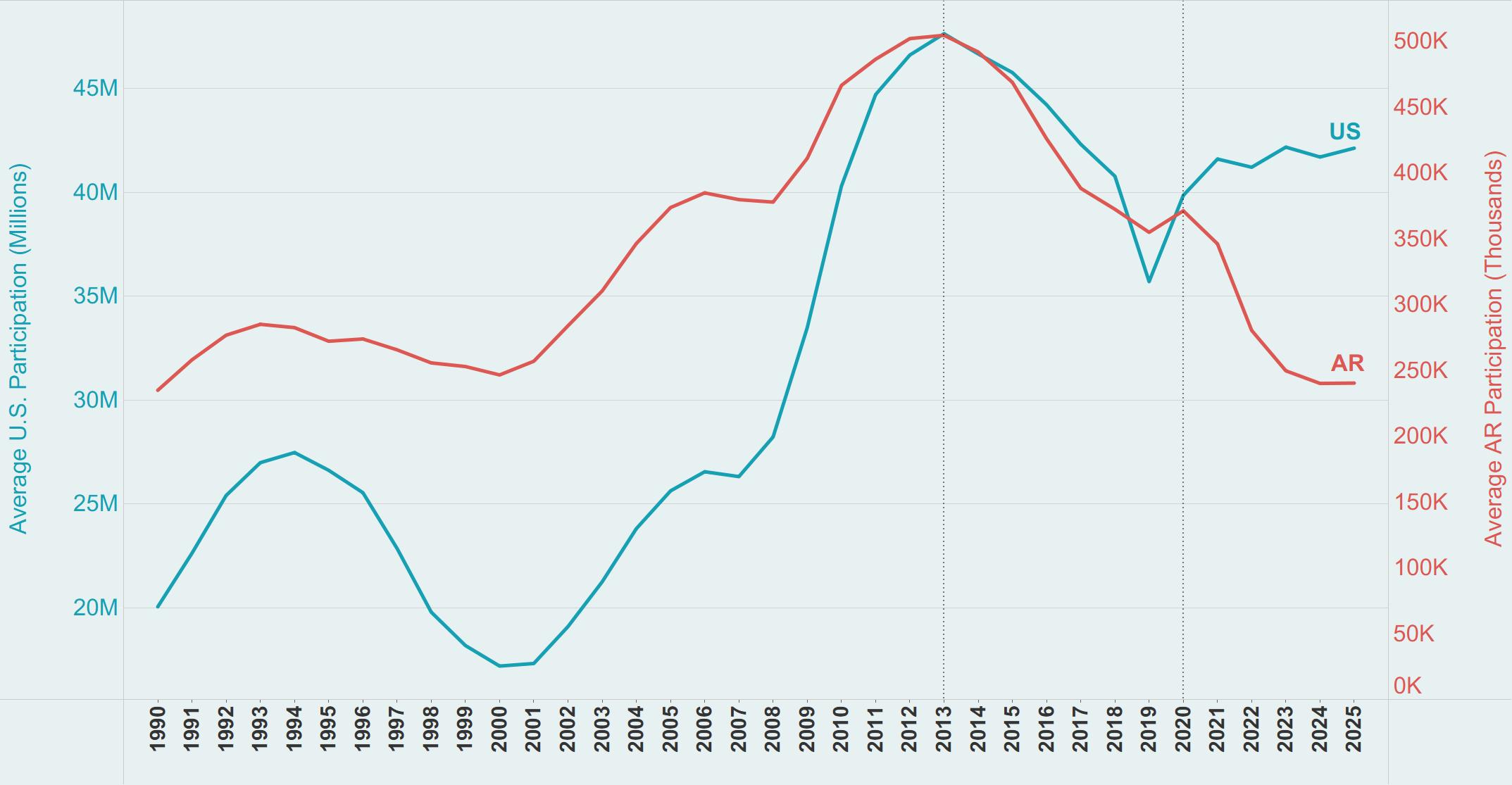
SNAP participation has fluctuated over time due to economic conditions, policy changes, and program expansions. Nationwide participation grew steadily until peaking in federal fiscal year 2013, then began to decline before stabilizing in recent years, as shown in Figure 1. Arkansas also reached a SNAP participation high in 2013, but since then participation in the state has declined each year, apart from a temporary pandemic-related increase in federal fiscal year 2020 and a very slight increase — about 150 people — in federal fiscal year 2025.4
Arkansas’s decline in SNAP participation, even as nationwide figures have stabilized, may reflect more restrictive state policies. For example, Arkansas has adopted broad-based categorical eligibility, a policy under which households may become categorically eligible for SNAP because they qualify for a non-cash benefit from the Temporary Assistance for Needy Families program or related state support required under that program; however, Arkansas uses the policy in a
FIGURE 1: SNAP PARTICIPATION TRENDS IN THE U.S. AND ARKANSAS4
more limited way than most states. Under Act 675 of 2023 and rules subsequently implemented by the Arkansas Department of Human Services, Arkansas allows a temporary increase to the SNAP resource limit for eligible households for 12 consecutive months, no more than once every five years, rather than eliminating the asset test entirely for SNAP households, as most other states have done under broad-based categorical eligibility. This topic is discussed in more detail in the “Eligibility Requirements and Benefits” section.
Additionally, prior to the passage of H.R. 1, states were allowed to waive SNAP’s three-month time limit on benefits for able-bodied adults without dependents who are deemed noncompliant with the program’s work requirement if they lived in areas with high unemployment or an insufficient number of jobs, but since 2016 Arkansas has not exercised this option.7
Declining SNAP participation also affects other support systems. In Arkansas, SNAP enrollment is used to identify children eligible for free school meals. If fewer eligible families are enrolled in SNAP, fewer children are identified as eligible for free school meals, affecting some school districts’ ability to qualify for or sustain the Community Eligibility Provision, a federal program that allows high-poverty schools to offer free meals to all students without collecting individual applications.8 When SNAP participation drops, some schools may lose access to the Community Eligibility Provision.9
Arkansas experienced a temporary increase in SNAP participation during the COVID-19 public health emergency, possibly due in part to the temporary suspension of the program’s eligibility time limit and work requirements, but participation has generally decreased since 2020. There were 240,378 Arkansans enrolled in SNAP in federal fiscal year 2025, compared to 371,265 in 2020.4
In federal fiscal year 2023, 34.0% of participating households in Arkansas included children, 26.3% included elderly individuals, and 29.7% included non-elderly individuals with disabilities.10 The racial breakdown of SNAP participants in Arkansas was 54.0% White, 34.3% African American, 2.0% Hispanic (any race), 2.7% other (not Hispanic), and 6.9% missing/unknown.
Table 1 shows that in federal fiscal year 2023, more Arkansans participating in SNAP were below the federal poverty level than were participants nationally.
Studies show that SNAP reduces food insecurity, particularly when benefits are increased,11 and access to the program in childhood is linked to lower risks of heart disease and obesity in adulthood.12 By promoting healthier diets and reducing food insecurity, SNAP has contributed to reduced overall healthcare expenditures among participants.
TABLE 1: PERCENTAGE OF SNAP PARTICIPANTS IN RELATION TO FEDERAL POVERTY LEVEL (FPL), FEDERAL FISCAL YEAR 2023a,10
| Zero Gross Income | 1% to 50% FPL | 51% to 100% FPL | 101% FPL or Above | |
|---|---|---|---|---|
| United States | 20.0 | 15.0 | 37.9 | 27.1 |
| Arkansas | 22.7 | 17.5 | 50.0 | 9.8 |
Eligibility Requirements and Benefits
In Arkansas, SNAP participants must meet eligibility criteria related to income, deductions, employment, and assets. Applicants must have gross monthly incomes (i.e., total household income before any deductions) at or below 130% of the federal poverty level and net monthly incomes (i.e., gross income minus SNAP’s allowable deductions) at or below 100% of the federal poverty level, adjusted for household size. For example, in fiscal year 2026, a family of two has a gross monthly income limit of $2,292 and a net limit of $1,763; a family of four has a gross limit of $3,483 and a net limit of $2,680.13
To determine net income for SNAP eligibility, certain deductions are applied to gross income. These include a standard deduction ($204 for households of one to three people in 2026), a 20% deduction on earned income, and deductions for unreimbursed medical expenses over $35 for elderly or disabled household members.14 Households can also deduct expenses related to caring for dependents, including expenses needed for childcare so household members can attend work or school, child support payments, and shelter costs (i.e., rent, utilities, and property taxes) in excess of half of post-deduction income.
Arkansas’s SNAP program also includes asset limits, also known as resource limits.13 Ordinarily, a household without elderly or disabled members can qualify for SNAP if its assets do not exceed $3,000, and a household that includes at least one person who is 60 or older or has a disability can qualify if its assets do not exceed $4,500. However, under Act 675 of 2023, Arkansas uses the broad-based categorical eligibility policy option to allow a temporary increase in the asset limit to $5,500 for up to 12 months, which households may access once every five years. This policy is intended to help low-income households build modest savings without losing SNAP eligibility.
While H.R. 1 did not change income threshold or asset limits for SNAP, it did change which enrollees are subject to work requirements. These changes are discussed in the section titled “Changes to SNAP Under H.R. 1.”
Allowable Food Purchases
SNAP benefits can be used to purchase most foods intended for home consumption, including fruits, vegetables, meat, dairy products, bread, and cereals, as well as seeds and plants that produce food. However, certain items are ineligible for purchase with SNAP benefits, including alcoholic beverages, tobacco products, hot foods, and any food sold for on-premises consumption.15 Nonfood items such as pet food, cleaning supplies, paper products, vitamins, medicines, household essentials, and personal care products are also not covered under the program.
PURCHASING PATTERNS
Studies show that many SNAP benefits are spent on foods similar to those purchased by non-SNAP households, including staples such as meat, vegetables, dairy products, and bread. Some evidence suggests that children in SNAP consume more sugar-sweetened beverages, high-fat dairy, and processed meats than income-eligible nonparticipants, although diet quality challenges are present across low-income children more broadly.16,17 Most SNAP households conduct their primary grocery shopping at supermarkets or supercenters, with a smaller percentage purchasing groceries at warehouse clubs, convenience stores, or farmers’ markets.18 These shopping preferences are influenced by factors such as store accessibility, pricing, and product availability.
WAIVER REQUESTS
Several states have sought USDA waivers to restrict certain SNAP purchases. These waivers typically prohibit the purchase of sugary foods such as soda and candy and other low-nutritional-value items with SNAP benefits. The Trump Administration has shown support for such waivers. Since June 2025, the USDA has approved SNAP “junk food” waivers for 22 states, including Arkansas.19
Arkansas’s waiver has a target implementation date of July 1, 2026. Under the waiver, the state will prohibit the use of SNAP benefits to purchase soda, fruit and vegetable drinks with less than 50% natural juice, “unhealthy” drinks, and candy. On May 12, 2026, the USDA approved a modification to Arkansas’s waiver that clarified beverage definitions. Among the restricted beverages listed in the waiver modification are ready-to-drink coffees, teas, chocolate drinks, or malt drinks with added sweeteners; sweetened flavored drinks without dairy or dairy substitutes; and energy drinks.20
A federal lawsuit filed March 11, 2026, by several SNAP recipients challenged the USDA’s approval of certain SNAP food restriction waivers.21 On June 23, 2026, a federal judge ruled that the USDA exceeded its legal authority in approving SNAP food restriction waivers and vacated the approvals in the five states named in the lawsuit: Colorado, Iowa, Nebraska, Tennessee, and West Virginia. Arkansas was not a defendant in the case, and the Arkansas Department of Human Services announced that the waiver would go into effect in the state July 1, 2026, as originally planned. However, an attorney for the plaintiffs asserted that Arkansas’s waiver would likely be vulnerable to a similar legal challenge.22
Changes to SNAP Under H.R. 1
Under H.R. 1, federal spending for SNAP is expected to be reduced by nearly $187 billion through 2034. This represents a 20% reduction in overall SNAP spending and the largest spending cut in the program’s history.
CHANGES TO THE THRIFTY FOOD PLAN
H.R. 1 makes changes to the Thrifty Food Plan (TFP), one of four food plans developed by the USDA that estimate the cost of a nutritious diet across various price points. The TFP, the least expensive of the four options, estimates the cost of a week’s worth of nutritious meals and is used to calculate SNAP benefit amounts. The TFP’s cost estimate for June of each year determines the maximum SNAP benefit amount for a household of four for the following October through September (the federal fiscal year).23,24
Under the 2018 Farm Bill, the USDA was required to reevaluate the TFP by 2022 and every five years thereafter, which was intended to ensure SNAP benefits accurately reflect current food costs and dietary guidelines.24 The USDA completed a reevaluation in 2021. In contrast to earlier reevaluations, the most recent of which was completed in 2006, the 2021 update resulted in changes that were not cost-neutral; benefits were increased by about $12 to $16 per person per month. H.R. 1 requires that future TFP reevaluations be cost-neutral, limiting the USDA’s ability to increase benefits to keep up with inflation. The next reevaluation may occur no earlier than October 1, 2027. The Congressional Budget Office anticipates that the cost-neutrality requirement of the TFP will lead to a $37 billion decline in SNAP spending over the next 10 years and that the average monthly SNAP benefit will decline by approximately $15 per person per month by 2034.
EXPANDED WORK REQUIREMENTS
H.R. 1 also makes significant changes to SNAP work requirements. Under previously existing federal law, able-bodied adults without dependents (ABAWDs) are required to work at least 80 hours a month or participate in a qualifying program to remain eligible for SNAP benefits. ABAWDs can only receive SNAP benefits for up to three months if they fail to meet the work requirement.25 H.R.1 leaves those work requirements in place, but it expands the definition of ABAWD, which previously included adults ages 18 to 54, to include adults ages 18 to 64. Additionally, SNAP recipients with dependents under age 18 were exempt from the work requirement previously, but under H.R. 1 the exemption is narrowed to those with dependents under age 14. H.R. 1 also ends work requirement exemptions that were established under the Fiscal Responsibility Act of 2023 for veterans, people experiencing homelessness, and former foster children.
H.R. 1 also narrows the applicability of geographic waivers from SNAP work requirements. Under prior law, states could request waivers for areas with unemployment over 10% or a “lack of sufficient jobs” in the local market, a relatively flexible standard. H.R. 1 removes the “lack of sufficient jobs” option, so waivers are now generally restricted to areas where the unemployment rate exceeds 10%.25 While Arkansas has not pursued ABAWD waivers since 2016, this more stringent threshold could matter if economic conditions within the state worsen in areas that do not meet the 10% unemployment threshold.
CHANGES TO HOUSEHOLD DEDUCTIONS
Under SNAP’s previous benefit calculation, households could deduct certain expenses, such as utility costs or internet expenses, from their gross income to determine their net income, allowing for a higher SNAP benefit amount. Changes to SNAP under H.R. 1 eliminate this option for most households, allowing only elderly or disabled household members to use energy assistance payments to qualify for utility deductions. The Congressional Research Service estimates that this change will lead to a benefit decrease of nearly $100 per month for approximately 3% of SNAP households in an average year.25
ELIMINATION OF SNAP-ED
Effective October 1, 2025, H.R. 1 eliminated previously mandatory funding for the Nutrition Education and Obesity Prevention Grant Program, known as SNAP-Ed, which provided nutrition education and outreach efforts to SNAP recipients. In Arkansas, a robust SNAP-Ed program was operated as a partnership between the University of Arkansas Cooperative Extension Service, the Arkansas Department of Human Services, and the USDA Food and Nutrition Service. A 2024 report found that more than 36,000 individuals were being served by SNAP-Ed through school programs, hands-on learning experiences, and food demonstrations.26
The University of Arkansas Cooperative Extension Service has worked to leverage funding through the Expanded Food and Nutrition Education Program (EFNEP) to fill gaps in nutrition education created by the ending of SNAP-Ed. EFNEP is a separate, federally funded nutrition education program that currently serves 14 mostly rural counties in Arkansas. The University of Arkansas Division of Agriculture has announced plans to expand services to at least five additional counties.27
COST SHIFT TO STATES
Prior to the passage of H.R. 1, SNAP administrative costs were split evenly between the states and the federal government, but beginning in October 2026, states will be required to pay 75% of administrative costs.23
For the first time, states may also be required to pay a share of SNAP benefit costs. A state’s share will be determined by its payment error rate — a measure of how accurately the state determines eligibility and benefit amounts based on a sample of cases reviewed each year by the state and the USDA. Payment errors include both overpayments and underpayments. A state with a payment error rate below 6% will not be required to pay a share of benefit costs. A state with a payment error rate of 6% to 8% will be required to pay 5% of benefits costs, a state with an error rate of 8% to 10 % will be required to pay 10% of benefit costs, and a state with an error rate above 10% will be required to pay 15% of benefit costs.
CHANGES TO NONCITIZEN ELIGIBILITY
Undocumented immigrants have never been eligible for SNAP. Lawfully present noncitizens have largely been ineligible, but exemptions have been allowed for refugees and asylum seekers. H.R. 1 limits SNAP eligibility to U.S. citizens, legal permanent residents, Cuban or Haitian entrants, and residents of certain Pacific Island nations (i.e., Compact of Free Association migrants, including Marshall Islanders). Refugees, individuals granted asylum, and survivors of trafficking are no longer eligible.28
Arkansas Impacts
Arkansas has consistently ranked among the most food-insecure states over the past decade. As of 2024, Arkansas was the most food-insecure state, with nearly 19% of residents struggling to afford or access nutritious food.3 While the state will experience significant impacts from the changes to SNAP under H.R. 1, Arkansas already had some of the most restrictive SNAP eligibility rules in the country. As noted above, Arkansas has had no SNAP work requirement waivers in place since 2016 and participates in broad-based categorical eligibility in a narrow way that retains asset limits. SNAP enrollment in Arkansas has been on the decline, but changes associated with H.R. 1 can be expected to reduce enrollment still further.
Federal changes to SNAP will shift an estimated $18 million in annual costs to Arkansas beginning in federal fiscal year 2027, and the state’s share of the cost could increase to as much as $25 million in subsequent years.29 The shifting of costs from the federal government to the states may force Arkansas and other states to make difficult choices. As states face new administrative obligations, they may experience limited caseworker capacity, delayed technology upgrades, increased program churn, and case backlogs.30
The Arkansas Department of Human Services reported the state’s payment error rate to be 7% in December 2025.31 This was an improvement from the state’s official 9.6% federal fiscal year 2024 payment error rate published by the USDA in June 2025, but Arkansas must get the rate below 6% to avoid becoming responsible for a share of SNAP benefit costs.32 At the current error rate, Arkansas faces becoming responsible for 5% of benefit costs, or $25 million of the state’s approximately $492 million in annual SNAP benefits.
The state’s fiscal year 2027 budget, signed by Governor Sarah Huckabee Sanders on April 29, 2026, includes $5 million for the state inspector general’s office under a “Program Integrity” line item.33 Information released by the governor’s office in advance of the fiscal session described this funding as supporting a reduction of the state’s SNAP payment error rate. Under H.R. 1, the share of SNAP administrative costs that states are responsible for will increase from 50%