
A large 2026 outbreak of the foodborne parasite Cyclospora and corresponding cases of the foodborne illness cyclosporiasis have raised nationwide attention around food safety. Cyclospora is primarily associated with contamination of produce at the agricultural production stage, but food safety risks can also arise during the handling, preparation, and storage stages.
This explainer details food contamination pathways, common causes and sources of foodborne illness, federal and state agencies responsible for food safety, food safety policies, recent surveillance changes, and consumer safety recommendations.
Food is considered contaminated if it has come in contact with pathogens, such as bacteria, viruses, or parasites; toxins, which may be produced by certain bacteria or molds; or unsafe chemicals.1 Contamination can occur through improper agricultural production methods, improper preparation, or exposure to excess moisture and heat.
Agricultural production methods, such as irrigation and pesticide treatment, are common contamination pathways. Irrigation water may contaminate crops if it contains human or animal feces or unsafe chemicals. These contaminants can enter water supplies through runoff from areas where manure or pesticides are used.2
Food contaminated with fecal matter may contain illness-causing pathogens.3 Pesticide residue may also remain on food, although the Environmental Protection Agency (EPA) sets limits on acceptable levels of pesticide residue on food that are well within levels safe for consumption.4 Chronic exposure to pesticides is associated with negative health effects.5
Inadequate heating of raw meat is a common cause of foodborne illness. Raw meat may contain harmful pathogens, which can be reduced to safe levels by cooking meat to its recommended internal temperature.6 Internal temperature recommendations are detailed below in the Consumer Recommendations section.
During food preparation, pathogens, toxins, or unsafe chemicals can be transferred between foods through cross-contamination. Cross-contamination occurs when knives, cutting boards, storage containers, or other preparation materials come in contact with contaminants and are then used to prepare food. For example, using the same cutting board for raw meat and vegetables can transfer pathogens to foods that will not be sufficiently cooked before consumption to render them safe.7
Exposure to elements such as heat and moisture can rapidly increase the growth of pathogens/toxins and shorten a food’s expected shelf life (the time before food spoils). Examples include frozen foods spoiling if left above the recommended temperature and bread molding faster in humid environments. The effects of exposure can be mitigated by proper storage techniques (detailed in the Consumer Recommendations section).
Foodborne illness, often called “food poisoning,” is caused by consuming contaminated food.
According to data from the Centers for Disease Control and Prevention’s (CDC) National Outbreak Reporting System, norovirus is the most frequently reported cause of foodborne outbreaksa in the U.S. In 2023, the most recent year for which data are available, 150 outbreaks were confirmed related to norovirus, resulting in 2,365 reported illnesses. However, despite causing fewer outbreaks (118), the most common cause of foodborne illness in 2023 was Salmonella bacteria, with 2,735 illnesses reported. In Arkansas, the most common cause of foodborne illness and related outbreaks is Salmonella, with 463 illnesses reported and three outbreaks confirmed in 2023.9 Several common foodborne pathogens or toxins and their associated illnesses are listed in Figure 1.
FIGURE 1: COMMON FOODBORNE PATHOGENS, ASSOCIATED ILLNESSES, AND SOURCES10
| Pathogen | Illness(es) | Food Source |
| Campylobacter | Campylobacteriosis | Raw and undercooked poultry, unpasteurized milk, contaminated water |
| Clostridium botulinum, Clostridium perfringens | Botulism, perfringens food poisoning | Improperly canned foods, fermented fish, baked potatoes in aluminum foil, meats, poultry, gravy, dried or precooked foods, time and/or temperature-abused foods |
| Escherichia coli (E. Coli) | E. coli infection (common cause of “travelers’ diarrhea”) | Water or food contaminated with human feces |
| Hepatitis A | Hepatitis | Raw produce, contaminated drinking water, uncooked foods, cooked foods that are not reheated after contact with an infected food handler, shellfish from contaminated waters |
| Norovirus | Variously called viral gastroenteritis, winter diarrhea, acute non-bacterial gastroenteritis, food poisoning, and food infection | Raw produce, contaminated drinking water, uncooked foods, cooked foods that are not reheated after contact with an infected food handler, shellfish from contaminated waters |
| Salmonella | Salmonellosis | Eggs, poultry, meat, unpasteurized milk or juice, cheese, contaminated fruits and vegetables |
While Cyclospora parasitic outbreaks are a relatively common occurrence in warmer months, the summer of 2026 has seen a drastic increase in the number of confirmed cases of cyclosporiasis, a gastrointestinal illness caused by Cyclospora. As of September 15, 2026, the CDC had confirmed 19,883 cases of cyclosporiasis with symptom onset dates between May 1, 2026, and August 31, 2026. An additional 6,594 cases of the illness had been identified and were under investigation. For comparison, the agency reported 1,180 total cases of cyclosporiasis from May 1 to August 31 in 2025.11 In Arkansas, 315 cases had been confirmed as of September 28, 2026 — more than 40 times the seven cases reported in 2025 — according to the Arkansas Department of Health (ADH).12 The CDC also reported that as of August 31, 2026, two deaths connected to the multistate outbreak had been reported nationwide.11 The 2026 outbreak is the largest documented cyclospora outbreak in the U.S.13 These numbers are being updated rapidly; visit the websites of the CDC and ADH for the most recent updates.
Federal, state, and local agencies work together to reduce foodborne illness risks, establish safety standards, inspect facilities, and investigate outbreaks.
Agencies charged with ensuring food safety in the U.S. include:
- Food and Drug Administration (FDA): Regulates most foods other than meat, poultry, and certain egg products. The FDA establishes food safety standards; conducts inspections; oversees compliance; manages outbreak detection, response and prevention; and works with state and local partners through programs such as the Coordinated Outbreak Response and Evaluation Network and the Partnership for Food Protection.14
- U.S. Department of Agriculture (USDA): Monitors meat, poultry, and egg product safety — primarily through its Food Safety and Inspection Service. Other USDA agencies, such as the Animal and Plant Health Inspection Service, focus on protecting animal and plant health and preventing agricultural pests and diseases.15
- Environmental Protection Agency (EPA): Regulates pesticide use and sets environmental standards that affect water quality and contamination risks.16
- Centers for Disease Control and Prevention (CDC): Collects, analyzes, and reports foodborne illness and outbreak data through systems including the Foodborne Diseases Active Surveillance Network, the System for Enteric Disease Response, Investigation, and Coordination, or SEDRIC; and the National Outbreak Reporting System.17,18
State public health and agriculture agencies maintain federal and state food standards.
ADH implements state food establishment rules based on the FDA Food Code. Its responsibilities include pre-opening, routine, and follow-up inspections addressing sanitation, food handling, and merchandise sourcing at food establishments and certain food manufacturers. Inspection results are regularly published by location and food establishment on the ADH website.19 The agency also maintains a “Food Establishment Complaint and Feedback” form, which consumers can use to file complaints or report suspected foodborne illness associated with a food establishment.20
The Arkansas Department of Agriculture conducts inspection, grading, and regulatory activities for animal- and plant-based products produced in the state. The agency works with the USDA to enforce food safety standards and monitor compliance.21
Notable events in the history of U.S. food safety policy include:22,23
- 1906: The Pure Food and Drugs Act and the Meat Inspection Act, two of the nation’s first food safety laws, are passed to prohibit unlisted additives in foods, drinks, and drugs and unsanitary meat-packing practices, respectively.
- 1938: The Federal Food, Drug, and Cosmetic Act gives the FDA authority to oversee the safety of food, drugs, medical devices, and cosmetics.
- 1969: The FDA begins administering sanitation programs for milk, shellfish, food service facilities, and interstate travel facilities.
- 1970: The Environmental Protection Agency is established; the new agency takes over an FDA program setting limits on the levels of pesticides on food.
- 1973: The FDA issues low-acid food processing regulations in response to botulism outbreaks caused by contaminated canned foods.
- 1997: The Food and Drug Administration Modernization Act is enacted to regulate food health claims, among other things.
- 2011: The FDA Food Safety and Modernization Act provides the FDA with new enforcement authority related to food safety standards, allows the agency to hold imported foods to the same standards as domestic foods, and directs the agency to build an integrated national food safety system in partnership with state and local authorities.
- 2022: The Food Traceability Rule is finalized (see below).
Recent Cyclospora Surveillance Changes
In 2025, following federal funding reductions, FoodNet, a foodborne illness surveillance program within the CDC, ceased requiring participating health agencies to report several pathogens, including Cyclospora, choosing instead to make reporting of these pathogens optional. Other federal and state surveillance systems continue to collect cyclosporiasis data. FoodNet collects trend data from a sample of states that actively report data, but the sample is not nationally representative. For these reasons, the CDC and state officials maintain that the changes to FoodNet surveillance likely did not contribute to the 2026 Cyclospora outbreak.18 Reduced reporting may limit analysis of long-term trends, however.
The Food Traceability Rule requires domestic and foreign entities that manufacture, process, pack, or hold high-risk foods to maintain a list of certain points along the items’ supply chain.24 Examples of high-risk foods include fresh herbs, fresh leafy greens, fresh cut vegetables, fresh cut fruits, ready-to-eat salads, sprouts, shell eggs, smoked fish, and crustaceans. The additional recordkeeping required under this rule is intended to promote faster response to contaminated foods. The rule was finalized in 2022, but Congress subsequently directed the FDA not to enforce the rule before July 20, 2028.
The 2026 cyclospora outbreak exemplifies the importance of prompt outbreak source detection.25 The improved tracing efforts mandated in this rule could increase the speed at which outbreak sources are detected and isolated.26
Federal, state, and local food safety measures reduce contamination risks, but the USDA, FDA, and CDC recommend additional safety steps when purchasing, preparing, and storing food.
The USDA recommends that consumers not purchase products with damaged or leaking containers. Furthermore, consumers should inspect products for signs of spoilage, such as odor or discoloration.27
Certain foods carry a greater risk of foodborne illness, and federal food safety agencies recommend that consumers consider these risks before purchasing. Leafy greens and root vegetables are the most likely to have fecal contamination and thus require careful washing before use.28 Other riskier foods include raw or undercooked seafood such as sushi, sashimi, or ceviche; unpasteurized milk and juices; and certain soft cheeses made with unpasteurized milk.6 These risks are compounded in certain populations, such as pregnant people, young children, older adults, and people with weakened immune systems. Consumers should also consider FDA guidance on fish purchasing and consumption due to varying levels of mercury contamination.29
The FDA recommends the following practices when preparing fresh produce:30
- Wash hands for 20 seconds with warm water and soap before and after preparing fresh produce.
- Cut away damaged or bruised areas before preparing or eating produce.
- Rinse produce before peeling to avoid transferring dirt and bacteria from the surface to the inside.
- Gently rub produce while holding under plain running water. There is no need to use soap or a produce wash.
- Use a clean vegetable brush to scrub firm produce, such as melons and cucumbers.
- Dry produce with a clean cloth or paper towel.
- Remove the outermost leaves of a head of lettuce or cabbage.
Safe food preparation is heavily reliant on cleanliness. The CDC recommends that consumers wash their hands with warm, soapy water for a minimum of 20 seconds — before, during, and after food preparation. The agency also urges consumers to reduce cross contamination during preparation by using separate cutting boards and prep bowls for raw foods, sanitizing the workspace, utensils, and thermometers after contact with raw foods, and washing hands after handling unwashed produce, raw meats, or eggs.
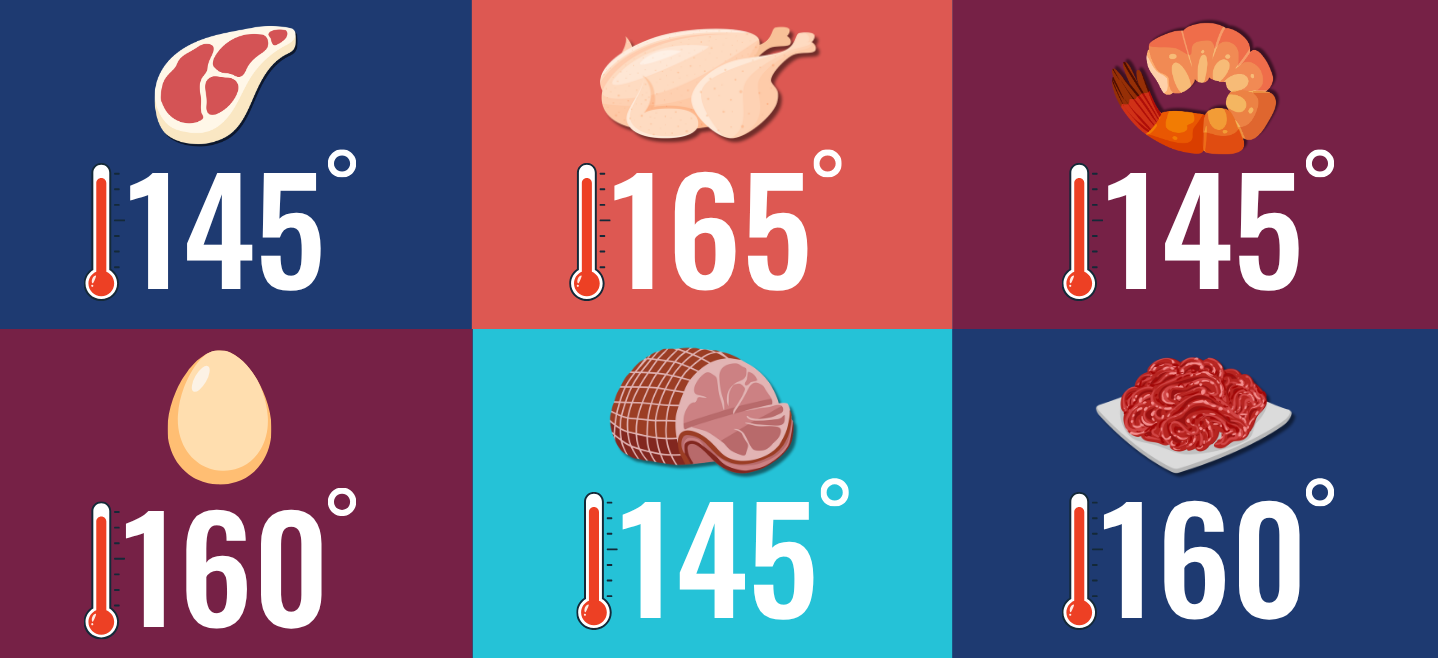
Additionally, the CDC advises that frozen raw meat and poultry should not be thawed at room temperature. Instead, thaw these foods in cold water, in the microwave, or in the refrigerator overnight.31 To reduce the risk of foodborne illness, consumers should ensure that raw meats and eggs have been cooked to their recommended temperatures before serving. Internal cooking temperatures recommended by the USDA are displayed by product type in Figure 2.32
FIGURE 2: RECOMMENDED INTERNAL COOKING TEMPERATURES32
According to the CDC, refrigerated food should be kept at or below 40 degrees Fahrenheit, and frozen items should be stored at zero degrees Fahrenheit or below. Perishable foods should be stored within two hours of purchase or preparation.31
If kept at the proper temperatures, frozen foods are safe indefinitely, according to the USDA.33 However, the agency recommends that refrigerated items be used within the following storage times:34
- 1-2 days: ground beef, turkey, veal, pork, and lamb; stew meats; variety meats; chicken; turkey; giblets; raw sausage; fresh fish and shellfish.
- 3-4 days: cooked casseroles; gravy and broth; patties; nuggets; soups and stews; store-cooked dinners and entrees; ham; cooked egg dishes.
- 3-5 days: steaks; chops; roasts; store-prepared (or homemade) egg, chicken, tuna, ham, and macaroni salads; opened luncheon meats; opened hot dogs.
- 1 week: bacon; smoked breakfast links; patties; hard-cooked eggs.
- 3-5 weeks: fresh eggs, in shell.
Recent federal and state initiatives have expanded food safety policy to include substances intentionally added to food.
The U.S. Department of Health and Human Services (HHS) and the FDA have announced actions focused on food additive oversight, including proposed changes to the oversight of generally recognized as safe (GRAS) substances, efforts to phase out certain synthetic dyes, and reviews of selected chemical additives in foods.35,36
Food companies have historically been able to self-certify chemicals or substances added to food as GRAS. A proposed FDA rule issued in August 2026 would require companies to report to the FDA when they reach a GRAS conclusion and the evidence used to support that conclusion.37 Additionally, in 2025, HHS and the FDA announced a series of new measures they said were intended to “phase out all petroleum-based synthetic dyes from the nation’s food supply.”36 These measures are part of a broader federal focus on reviewing chemical additives in food.35
The federal focus on food additives was also reflected in Arkansas through the Make Arkansas Healthy Again Act of 2025, which prohibits propylparaben (a preservative) and potassium bromate (an oxidizing agent used in baked goods) from being added to foods manufactured, distributed, or sold in Arkansas. The law will take effect January 1, 2028.38 This Arkansas policy, and related federal initiatives, reflect an interest not only in preventing accidental contamination and responding to foodborne illness but also in enhanced regulation of food additives.
While federal, state, and local agencies regulate and monitor the food supply, foodborne illnesses still occur. National outbreaks of foodborne illness, such as the 2026 cyclospora outbreak, have renewed attention to policies such as the Food Traceability Rule, which is intended to help increase the speed at which outbreak response efforts can be deployed.
Beyond outbreak containment procedures, there are additional, ongoing food safety efforts focused on certain synthetic dyes and preservatives in foods. Recent federal and Arkansas initiatives reflect growing attention to these additives.
Consumers can also reduce their risk of consuming contaminants and contracting foodborne illnesses by following recommended food safety techniques when purchasing, handling, preparing, and storing food.
a As defined by the CDC, an outbreak occurs when there are more disease cases than what is usually expected for a given time, within a specific location, or for a specific population.8
1 What is food contamination? U.S. Department of Agriculture. May 24, 2024. Accessed September 2, 2026. https://ask.fsis.usda.gov/article/What-is-food-contamination
2 Centers for Disease Control and Prevention. Agricultural water and your safety. CDC.gov. February 14, 2024. Accessed July 17, 2026. https://www.cdc.gov/agricultural-water/about/index.html
3 Food poisoning (foodborne illness). Mayo Clinic. July 16, 2026. Accessed September 2, 2026. https://www.mayoclinic.org/diseases-conditions/food-poisoning/symptoms-causes/syc-20356230
4 Food and pesticides. Environmental Protection Agency. February 10, 2026. Accessed July 17, 2026. https://www.epa.gov/safepestcontrol/food-and-pesticides
5 Shekhar C, Khosya R, Thakur K, et al. A systematic review of pesticide exposure, associated risks, and long-term human health impacts. Toxicol Rep. 2024;13. doi:10.1016/j.toxrep.2024.101840
6 Centers for Disease Control and Prevention. Safer food choices. CDC.gov. January 31, 2025. Accessed July 22, 2026. https://www.cdc.gov/food-safety/foods/safer-food-choices.html
7 Food Safety Education Month: preventing cross-contamination. U.S. Department of Agriculture. Accessed July 22, 2026. http://www.fsis.usda.gov/news-events/events-meetings/food-safety-education-month-preventing-cross-contamination
8 Centers for Disease Control and Prevention. Outbreak and case definitions. CDC.gov. May 28, 2024. Accessed September 18, 2026. https://www.cdc.gov/urdo/php/surveillance/outbreak-case-definitions.html
9 Centers for Disease Control and Prevention. BEAM Dashboard. CDC.gov. February 26, 2026. Accessed July 17, 2026. https://www.cdc.gov/beam/dashboard/
10 Foodborne illness-causing organisms in the U.S. Food and Drug Administration. Accessed September 8, 2026. https://www.fda.gov/media/77727/download
11 Centers for Disease Control and Prevention. Cyclosporiasis case data. CDC.gov. September 15, 2026. Accessed September 17, 2026. https://www.cdc.gov/cyclosporiasis/php/surveillance/index.html
12 Arkansas Department of Health. Cyclosporiasis. Accessed September 17, 2026. https://healthy.arkansas.gov/programs-services/diseases-conditions/communicable-diseases/cyclosporiasis/
13 McPhillips D. Cyclosporiasis outbreak has affected about 1 in every 1,000 people in Michigan and killed two. CNN. August 6, 2026. Accessed September 3, 2026. https://www.cnn.com/2026/07/21/health/cyclospora-cases-count
14 Microbiological safety: the FDA’s role in preventing foodborne illness. Food and Drug Administration. October 1, 2024. Accessed July 21, 2026. https://www.fda.gov/about-fda/human-foods-program/microbiological-safety-fdas-role-preventing-foodborne-illness
15 Food safety agencies & partners. U.S. Department of Agriculture. Accessed July 21, 2026. http://www.fsis.usda.gov/about-fsis/food-safety-agency-partners
16 Nonpoint source: agriculture. Environmental Protection Agency. July 21, 2026. Accessed July 21, 2026. https://www.epa.gov/nps/nonpoint-source-agriculture
17 Centers for Disease Control and Prevention. What CDC is doing. CDC.gov. May 2, 2024. Accessed July 21, 2026. https://www.cdc.gov/food-safety/about/what-cdc-is-doing.html
18 Centers for Disease Control and Prevention. About FoodNet. CDC.gov. April 28, 2026. Accessed September 9, 2026. https://www.cdc.gov/foodnet/about/index.html
19 Arkansas Department of Health. Restaurant/food establishment inspection search. Accessed September 11, 2026. https://foodserviceprod.adh.arkansas.gov/Web/inspection/publicinspectionsearch.aspx
20 Food Protection Inspection Portal. Arkansas Department of Health. Accessed July 22, 2026. https://healthy.arkansas.gov/programs-services/public-health-safety/food-protection-inspection-portal/
21 Food safety. Arkansas Department of Health. Accessed July 27, 2026. https://agriculture.arkansas.gov/food-safety/
22 Location of FDA and its predecessors in federal government. Food and Drug Administration. January 31, 2018. Accessed July 21, 2026. https://www.fda.gov/about-fda/changes-science-law-and-regulatory-authorities/location-fda-and-its-predecessors-federal-government
23 Milestones in U.S. food and drug law. Food and Drug Administration. January 30, 2023. Accessed July 21, 2026. https://www.fda.gov/about-fda/fda-history/milestones-us-food-and-drug-law
24 Congressional Research Service. The Food and Drug Administration’s Food Traceability Rule: overview and issues for Congress. Congress.gov. April 29, 2026, Accessed July 27, 2026. https://www.congress.gov/crs-product/R48925
25 Holohan M. A difficult-to-trace parasite, messaging missteps contribute to summer of overwhelming Cyclospora outbreaks. CIDRAP. July 28, 2026. Accessed August 6, 2026. https://www.cidrap.umn.edu/cyclospora/difficult-trace-parasite-messaging-missteps-contribute-summer-overwhelming-cyclospora
26 FSMA final rule on requirements for additional traceability records for certain foods. Food and Drug Administration. July 24, 2026. Accessed August 7, 2026. https://www.fda.gov/food/food-safety-modernization-act-fsma/fsma-final-rule-requirements-additional-traceability-records-certain-foods
27 Keep food safe! Food safety basics. U.S. Department of Agriculture. Accessed October 1, 2026. http://www.fsis.usda.gov/food-safety/safe-food-handling-and-preparation/food-safety-basics/steps-keep-food-safe
28 Lerner R. The scoop on poop. Purdue University. March 7, 2017. Accessed September 16, 2026. https://www.purdue.edu/hla/sites/yardandgarden/the-scoop-on-poop/
29 EPA-FDA advice about eating fish and shellfish. Environmental Protection Agency. November 6, 2025. Accessed July 22, 2026. https://www.epa.gov/choose-fish-and-shellfish-wisely/epa-fda-advice-about-eating-fish-and-shellfish
30 7 tips for cleaning fruits, vegetables. Food and Drug Administration. June 15, 2021. Accessed July 22, 2026. https://www.fda.gov/consumers/consumer-updates/7-tips-cleaning-fruits-vegetables
31 Centers for Disease Control and Prevention. Preventing food poisoning. November 24, 2025. Accessed September 8, 2026. https://www.cdc.gov/food-safety/prevention/index.html
32 Safe minimum internal temperature chart. U.S. Department of Agriculture. April 14, 2025. Accessed July 17, 2026. http://www.fsis.usda.gov/food-safety/safe-food-handling-and-preparation/food-safety-basics/safe-temperature-chart
33 Freezing and food safety. U.S. Department of Agriculture. August 9, 2024. Accessed July 23, 2026. http://www.fsis.usda.gov/food-safety/safe-food-handling-and-preparation/food-safety-basics/freezing-and-food-safety
34 Refrigeration & food safety. U.S. Department of Agriculture. March 23, 2015. Accessed July 23, 2026. http://www.fsis.usda.gov/food-safety/safe-food-handling-and-preparation/food-safety-basics/refrigeration
35 Make American Healthy Again Commission. Make our children healthy again. Accessed August 13, 2026. https://www.whitehouse.gov/wp-content/uploads/2025/09/The-MAHA-Strategy-WH.pdf
36 HHS, FDA to phase out petroleum-based synthetic dyes in nation’s food supply. News release. U.S. Department of Health and Human Services. April 22, 2025. Accessed August 13, 2026. https://www.hhs.gov/press-room/hhs-fda-food-dyes-food.html
37 U.S. Department of Health and Human Services, Food and Drug Administration. Substances generally recognized as safe. Federal Register. August 11, 2026. Accessed September 4, 2026. https://www.federalregister.gov/d/2026-16296
38 The Make Arkansas Healthy Again Act, Act 622, 95th General Assembly, Regular Session 2025, (Ark 2025). Accessed August 6, 2026. https://arkleg.state.ar.us/Home/FTPDocument?path=%2FACTS%2F2025R%2FPublic%2FACT622.pdf