Automated external defibrillators (AEDs) are life-saving tools used to help individuals experiencing sudden cardiac arrest. Survival from sudden cardiac arrest outside of a hospital setting is highly dependent on how quickly cardiopulmonary resuscitation (CPR) and defibrillation occur. While Arkansas law requires AED availability in certain public settings and clinical settings, those requirements do not extend to most outpatient healthcare facilities.
This explainer provides an overview of AEDs, reviews federal and state laws and regulations pertaining to AED acquisition and placement, and identifies healthcare settings where current Arkansas requirements do not reach.
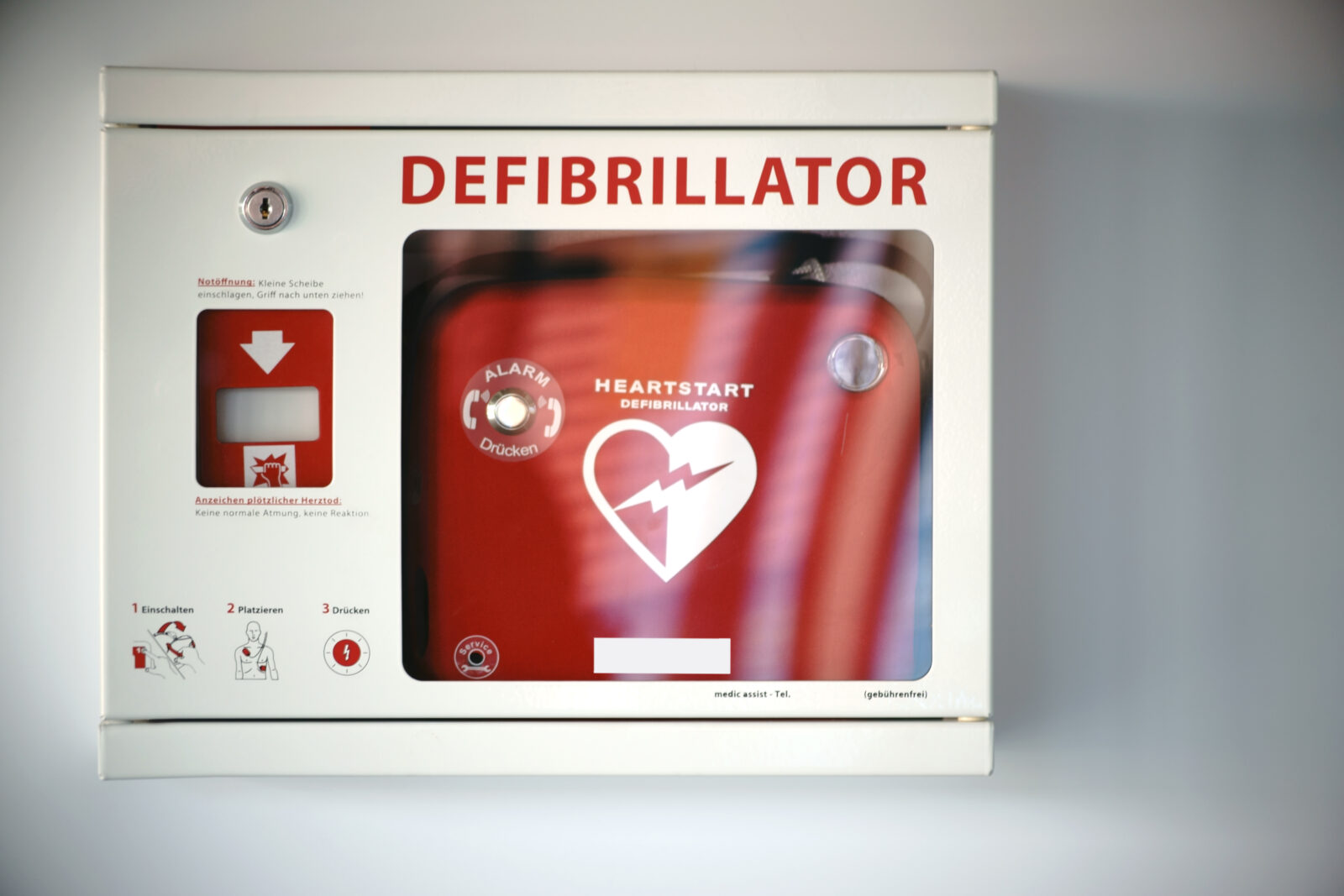
Sudden cardiac arrest occurs when the heart suddenly stops pumping blood effectively because of an irregular heart rhythm. An AED is a portable, computerized medical device that can be used to analyze the heart rhythm of an individual experiencing sudden cardiac arrest and, if appropriate, deliver defibrillation — an electric shock that may restore the heart to its normal rhythm. AEDs are typically used in combination with CPR, a procedure that can consist of applying chest compressions or both chest compressions and rescue breaths.1
- CALL 911: Call emergency services or direct another person to call.
- USE CPR: Begin CPR immediately while the AED is retrieved.
- USE THE AED: Follow the device prompts and deliver a shock if advised.
AEDs can be semi-automated or fully automated. A semi-automated AED prompts the user to press a button to deliver a defibrillation shock. A fully automated AED automatically delivers a defibrillation shock if the device determines one is needed.
There are two main types of AEDs: public access AEDs and professional-use AEDs.2 Public access AEDs include those found in public settings such as airports, community centers, and government buildings, and are intended to be used by laypeople who have received some or no training in the use of AEDs. In contrast, professional-use AEDs are used by first responders such as paramedics who receive specialized AED training.
Swift initiation of CPR and defibrillation significantly increases the chances of surviving sudden cardiac arrest. Among adults who experienced an out-of-hospital cardiac arrest between 2013 and 2024, 10.0% survived to hospital discharge.3 Among out-of-hospital cardiac arrests not witnessed by a 911 responder, a bystander used an AED in 6.9% of cases, and 15.1% of those patients survived to hospital discharge. For this reason, AED placement policies have been established to help make defibrillation available before emergency medical services arrive.
As medical devices, AEDs are subject to U.S. Food and Drug Administration (FDA) approval and are monitored by the FDA for safety and possible recalls. At the federal level, the Cardiac Arrest Survival Act of 2000 required the development of guidelines for placing AEDs in federal buildings and provided civil immunity protections for AED use in certain circumstances.
States typically have laws establishing requirements for individuals or entities that acquire AEDs, addressing issues such as training, device maintenance, and notification of emergency medical services when an AED is used. All 50 states have “good Samaritan” laws that provide civil liability protection for the use of an AED in an emergency.
In Arkansas, the Public Access to Automated External Defibrillation Act establishes requirements for a person or entity that acquires an AED.4 These requirements include:
- Ensuring that expected users complete appropriate courses in CPR and AED use at least once every two years.
- Properly maintaining and testing an AED in accordance with the manufacturer’s operational guidelines and instructions.
- Contacting emergency medical services as soon as possible when an AED is used, alerting emergency medical services of the location where AED was used and the type of AED used, and reporting AED use to the responding medical provider.
Arkansas also requires AEDs in certain public settings. Elementary and secondary school campuses must have an AED on site and ensure that appropriate school personnel are adequately trained on an ongoing basis to use an AED. AEDs are also required at school-sponsored sports events for 7th through 12th grades. School districts may apply for a grant from the Arkansas Department of Health to purchase an AED and/or to support personnel training costs.5 Public universities and colleges in Arkansas are required to place AEDs in appropriate locations across each campus and have an AED available at every institution-sponsored sports event.6
Outside of school settings, “health spas” (a term that broadly includes fitness centers or gyms) are required to maintain at least one accessible AED on their premises and ensure at least one employee who has completed CPR and AED training is on duty during business hours.4
The Arkansas Department of Public Safety also requires that a first aid kit and an AED be available in a secure but easily accessible location within a criminal detention facility. These facilities are also required to establish a medical training program that includes training in first aid and CPR/AED use. The standards also note that all custody personnel are required to maintain certification for life-saving techniques and devices.7
Under the Arkansas Medical Practices Act statutes and rules, medical offices where office-based surgery is performed are required to have a defibrillator on site.8
States have taken varied approaches to AED requirements. Many state AED requirements apply to public settings where large numbers of people gather, while others apply to certain healthcare facilities or services. Some states also require AEDs at public swimming pools, state government buildings, and large-occupancy buildings.
Additionally, numerous states require assisted living facilities or nursing facilities to maintain an onsite AED. For example, Florida requires assisted living facilities with 17 or more beds to maintain a functioning AED on site.9
In outpatient healthcare settings, many states link the requirement for onsite AEDs to specific healthcare services that may increase the risk of sudden cardiac arrest. Illinois, for example, requires an onsite AED in dental offices that administer anesthesia or sedation.10 New York takes a broader approach, requiring all dental facilities to maintain an onsite AED or other defibrillator, regardless of whether anesthesia or sedation are administered.11
Rhode Island takes an even broader approach. The state requires AEDs in all public places, defined as enclosed areas that are open to the public and can hold 300 or more people, and in all healthcare facilities.12 Any person who owns or operates either type of facility must maintain an onsite AED and at least one person trained in AED operation and use. The statute defines “healthcare facilities” to include outpatient settings such as clinics, treatment centers, diagnostic centers, neighborhood health centers, and practitioners’ offices. Unlike other states that link AED requirements to the types of services provided in outpatient care settings, Rhode Island’s requirement reaches any facility that provides outpatient care.
New Jersey introduced legislation in early 2026 that would require on-site AEDs and staff training in the use of AEDs at urgent care centers (UCCs) and retail health clinics. Similar bills were introduced in the state’s 2020-2021, 2022-2023, and 2024-2025 sessions but were not enacted. The latest measure was referred to a Senate committee on January 13, 2026, but no subsequent action has taken place as of September 2026.13
Use of UCCs has grown rapidly in recent years, offering an alternative for patients with acute health issues to be treated the same day. A UCC can also fill a gap when a patient’s health issue occurs outside their primary care physician’s office hours, but the patient does not consider it an emergency.14 UCCs are one outpatient setting where Arkansas does not impose a uniform on-site AED requirement.
While UCCs are intended to address conditions that are not considered life-threatening, patients may arrive with symptoms that are more serious than they recognize, or their conditions may rapidly deteriorate while at the UCC. In the event of a sudden cardiac arrest, immediate access to an AED could enable the clinic’s staff to provide potentially life-saving treatment while awaiting the arrival of emergency medical services. Whether UCCs are subject to onsite AED requirements depends in part on how the facilities are structured and regulated.
UCC oversight varies based on how a facility is owned and operated and the services provided. Some UCCs operate as departments of a hospital and may be subject to applicable state hospital licensing and Medicare participation requirements. Others may be owned or affiliated with a hospital but operate as separate clinics, so hospital-based requirements generally would not apply. Arkansas does not license non-hospital-based UCCs as a distinct type of healthcare facility, and UCCs are not listed as a separate health facility services category licensed or certified by the Arkansas Department of Health.15 However, healthcare professionals employed by UCCs are subject to their respective professional licensing board standards. Because Arkansas does not license UCCs as a distinct type of healthcare facility, there is no uniform AED requirement across UCCs.
Some states, including Arizona, New Hampshire, and Vermont, have adopted regulatory frameworks for UCCs, establishing a mechanism for imposing facility-level standards.16 Massachusetts enacted legislation in January 2025 to create a separate licensure category for UCCs, defined as clinics that provide walk-in care and are not corporately affiliated with a licensed hospital.17 The law gives discretion to the Massachusetts Department of Public Health to set licensure requirements, impose fines, and suspend or revoke licenses. While these state examples may not necessarily include onsite AED requirements, these frameworks provide a path by which states can establish facility-level standards for UCCs.
Accreditation and certification offer another source of oversight. The Joint Commission, as an example, accredits urgent and immediate care centers under its Ambulatory Health Care Accreditation program.18 There are also urgent care-specific accreditation programs, including one offered by the Urgent Care Association.19 These programs help to establish standards at the facility level, but participation is voluntary, and the established standards only apply to the accredited facilities. Arkansas currently requires neither accreditation or certification for a UCC to operate within the state.
Health insurers may also establish operational requirements through provider credentialing and network participation agreements. These requirements can function as a form of indirect oversight by requiring clinics to maintain certain equipment, procedures, or accreditation to participate in an insurer’s network. However, such requirements vary among insurers and do not necessarily apply to all UCCs.
Accreditation, certification, and insurer requirements only reach facilities that participate in such initiatives and do not establish a uniform standard across facilities. However, some UCCs may maintain AEDs voluntarily, based on industry standards and best practices.
As has been the case for requirements in other locations, an on-site AED requirement for outpatient healthcare facilities would require consideration of questions such as which types of facilities would be covered, how AEDs would be made accessible and properly maintained, what training and emergency response standards would apply, and how compliance would be monitored. Table 1 suggests some options for consideration.
TABLE 1: OPTIONS FOR ON-SITE AED REQUIREMENTS
| Covered Facilities | o Define the types of facilities subject to an on-site AED requirement, including whether it should apply only to UCCs or extend to other outpatient settings. o Consider whether requirements should vary based on services provided, patient volume, operating hours, or proximity to emergency medical services. |
| AED Access and Maintenance | o Require at least one AED to be readily accessible to clinic staff when the facility is open. o Require facilities to inspect, test, and maintain AEDs in accordance with manufacturer guidelines. o Establish standards for AED placement (including signage) and replacement of batteries and electrode pads. |
| Training and Emergency Response | o Require at least one trained staff member to be present when the facility is open. o Establish procedures based on best practices for initiating CPR, using an AED, and contacting emergency medical services. o Require personnel to maintain appropriate CPR and AED training or certification through a recognized organization, such as the American Heart Association or the American Red Cross. |
| Oversight and Enforcement | o Identify the state agency, licensing board, or other entity responsible for monitoring compliance. o Establish corrective action plans or penalties for facilities that do not comply with an on-site AED requirement. |
Arkansas law requires on-site AEDs at schools, public college and university campuses, health spas, criminal detention facilities, and clinical settings where office-based surgery is performed. Arkansas does not currently impose a general on-site AED requirement on outpatient clinics, including UCCs, as a facility category, although certain outpatient settings are subject to AED or defibrillator requirements based on the services provided. Whether to establish such a requirement would involve decisions about which facilities should be covered and how access, training, maintenance, and compliance should be addressed.
1 Kleinman, M. E., Buick, J. E., Huber, N., Idris, A. H., Levy, M., Morgan, S. G., Nassal, M. J., Neth, M. R., Norii, T., Nunnally, M. E., Rodriguez, A. J., Walsh, B. K., & Drennan, I.R. (2025). Part 7: Adult basic life support: 2025 American Heart Association guidelines for cardiopulmonary resuscitation and emergency cardiovascular care. Circulation, 152(suppl 2):S448–S478. doi:10.1161/CIR.0000000000001369
2 U.S. Food and Drug Administration. (October 22, 2024). Automated external defibrillators (AEDs). https://www.fda.gov/medical-devices/cardiovascular-devices/automated-external-defibrillators-aeds#what
3 Cardiac Arrest Registry to Enhance Survival. (2025). CARES survival report. https://mycares.net/sitepages/uploads/2025/CARES%202013-2024%20Non-Traumatic%20National%20Survival%20Report.pdf
4 Ark. Code Ann. § 20-13-1301 et seq.
5 Ark. Code Ann. § 6-10-122 to -123.
6 Ark. Code Ann. § 6-60-121.
7 Arkansas Department of Public Safety, Office of Criminal Detention Facilities Review Committees. (2022). Minimum standards for adult criminal detention facilities. https://media.ark.org/dps/Criminal-Detention-Facility-Standards-FINAL-November-2022.pdf
8 Arkansas State Medical Board. (2025). Arkansas Medical Practices Act statutes and rules. https://www.armedicalboard.org/professionals/pdf/mpa.pdf
9 Fla. Stat. § 429.255.
10 225 Ill. Comp. Stat. 25/44.5.
11 NY Educ. Law §6611(10).
12 RI Gen. Laws §§23-6.5-2, 23-6.5-4.
13 Senate Bill 2393, 2026-2027 Sess. (2026). New Jersey Legislature. https://www.njleg.state.nj.us/bill-search/2026/S2393
14 Burke, K. (2026, January 28). Urgent care spending increased by 50% over 5 years driven by higher use. Health Care Cost Institute. https://healthcostinstitute.org/all-hcci-reports/urgent-care-spending-increased-by-50-over-5-years-driven-by-higher-use/
15 Arkansas Department of Health. Applications for new providers & change of ownership. Accessed July 28, 2026. https://healthy.arkansas.gov/programs-services/licensing-military-member-licensure-permits-plan-reviews/health-facility-services/applications-for-new-providers-change-of-ownership/
16 Community Catalyst & National Health Law Program. (2022). Making ‘convenient care’ the right care for all: Improving state oversight of urgent care centers and retail health clinics. https://www.communitycatalyst.org/wpcontent/uploads/2022/11/Urgent-Care-Center-BriefAppendix-2.pdf
17 Ayers, A. (2025, March 30). State legislation could impact urgent care facilities. The Journal of Urgent Care Medicine. https://www.jucm.com/state-legislation-could-impact-urgent-care-facilities/
18 Joint Commission. Why choose us: Ambulatory health care. Accessed August 3, 2026. https://www.jointcommission.org/en-us/about-us/why-choose-us/ambulatory-health-care
19 Urgent Care Association. Accreditation terms. Accessed August 3, 2026. https://urgentcareassociation.org/quality/accreditation-terms