
Medicaid is the nation’s public health insurance program, providing coverage to approximately 1 in 4 Arkansans, many of whom have complex and costly needs for care.1 The Medicaid program has continued to evolve and expand since its establishment in 1965, resulting in historic reductions in the number of Americans without health insurance coverage.
Changes to the Medicaid program are frequently debated, including efforts to rein in costs while also ensuring sufficient access to quality care. To better understand the impacts of proposed changes, a thorough understanding of Medicaid and its history is critical. This explainer provides an overview of Medicaid in Arkansas, including its history, its financing structure, covered populations and benefits, and anticipated changes.
Medicaid is a jointly financed federal and state program which has historically provided healthcare coverage to the country’s low-income children and their parents, pregnant women, individuals with disabilities, and low-income seniors. In 1965, President Lyndon B. Johnson signed legislation establishing Medicaid and another program, Medicare, which provides coverage to Americans age 65 and over and some medically vulnerable populations. Established as Title XIX of the Social Security Act, the federal Medicaid law offered states the opportunity to match state dollars with federal funding to establish medical assistance programs.
Prior to the passage of Title XIX, Arkansas had a limited program to provide medical care to indigent populations through Act 280 of 1939.2 In 1970, Arkansas chose to participate in the federal option of Medicaid under the administration of Governor Winthrop Rockefeller, allowing the state to provide coverage to other low-income populations.
The Arkansas Department of Human Services is the agency that oversees the state’s Medicaid program. The U.S. Centers for Medicare and Medicaid Services (CMS) administers the federal Medicaid program for the U.S. Department of Health and Human Services. CMS also authorizes federal funding levels, approves each state’s Medicaid state plan (i.e., the formal agreement describing how the state administers its Medicaid program), and ensures compliance with federal regulations. Since the late 1970s, Arkansas Medicaid has undergone many revisions to its state plan in order to meet the needs of changing populations and capitalize on opportunities for state innovation.
Arkansas Medicaid functions as a safety net for low-income residents and certain groups with special needs, including children from low-income families (who receive coverage through the ARKids First program; see below); individuals who have developmental disabilities and/or serious mental illnesses; frail, elderly adults with limited financial resources; and those who qualify as disabled and receive benefits through the federal Supplemental Security Income program. These eligibility groups are often divided into two categories: (1) those whose eligibility is determined using the modified adjusted gross income (MAGI) method, which generally includes children, pregnant women, parents and caretaker relatives, and adults covered through Medicaid expansion (see below); and (2) those whose eligibility is determined by the non-MAGI method, which generally includes individuals receiving Supplemental Security Income, elderly adults, individuals with disabilities, and individuals receiving long-term services.3
In May 1997, Arkansas submitted its proposal for ARKids First, a program to expand coverage to children in families with incomes up to 200% of the federal poverty level who were not eligible for traditional Medicaid coverage. On a parallel track in the same year, Congress established the State Children’s Health Insurance Program (CHIP) to extend healthcare coverage to children of low-income families. To align ARKids First with federal Medicaid and CHIP eligibility rules and funding regulations, the program was separated into ARKids A and B in 2000.4 ARKids A is Medicaid coverage for eligible children, while ARKids B is CHIP coverage for children who are not eligible for Medicaid.5 Whether a child participates in ARKids A or B is based on the family’s income. There is no cost sharing when a child participates in ARKids A; for ARKids B, co-payments are required for some services.
Arkansas has historically maintained strict eligibility requirements for Medicaid enrollment. Eligibility is based on many factors, including income, state residency, and disability status. Before Arkansas opted in to Medicaid expansion under the Patient Protection and Affordable Care Act (ACA) in 2014, coverage was generally limited to certain categorical groups. These limited eligibility groups included children, pregnant women, people with disabilities, older adults, and some parents or caretaker relatives with very low incomes. Many states used waiver authority to expand access to additional low-income adults, but prior to Medicaid expansion, Arkansas largely did not.6
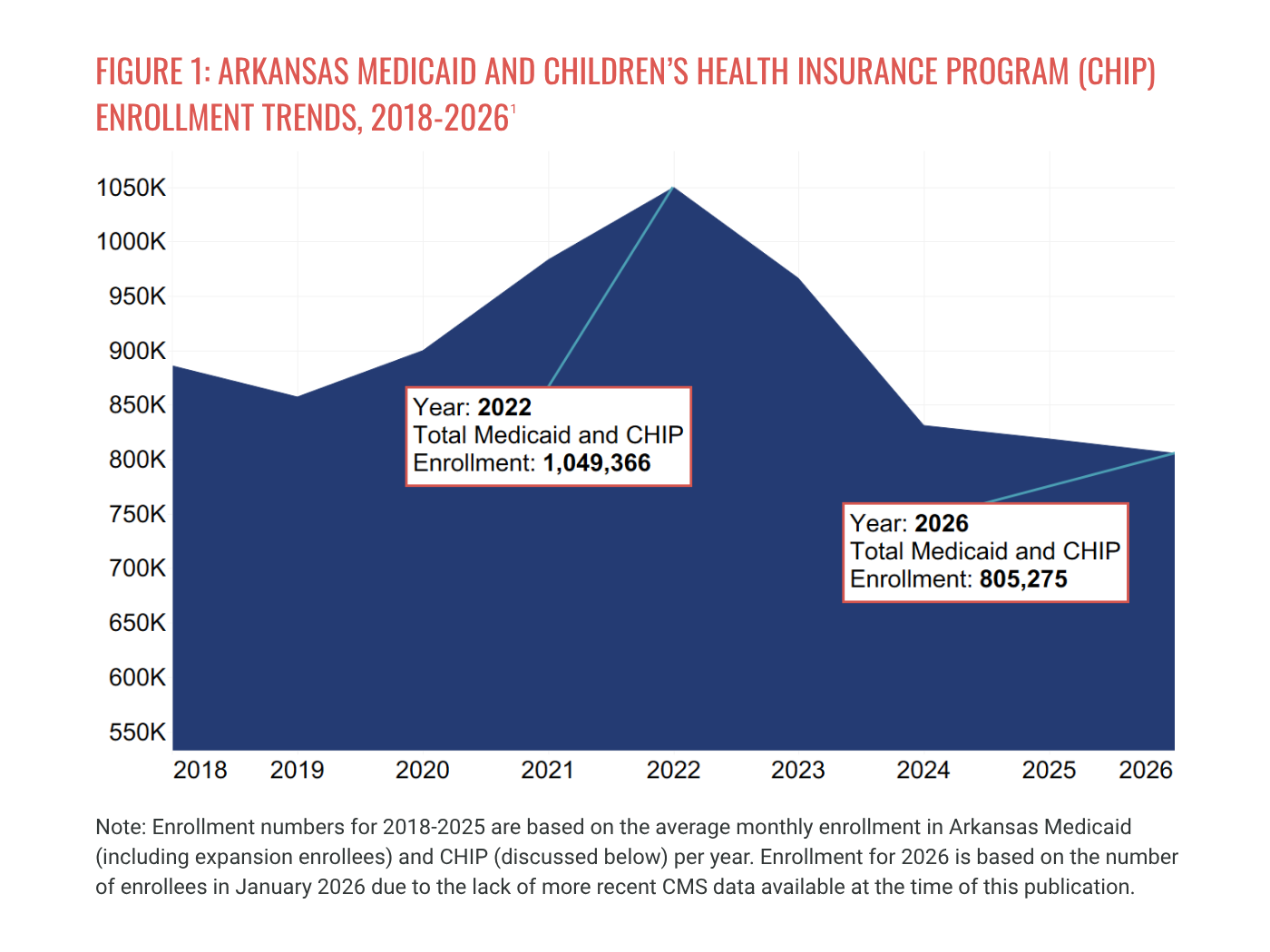
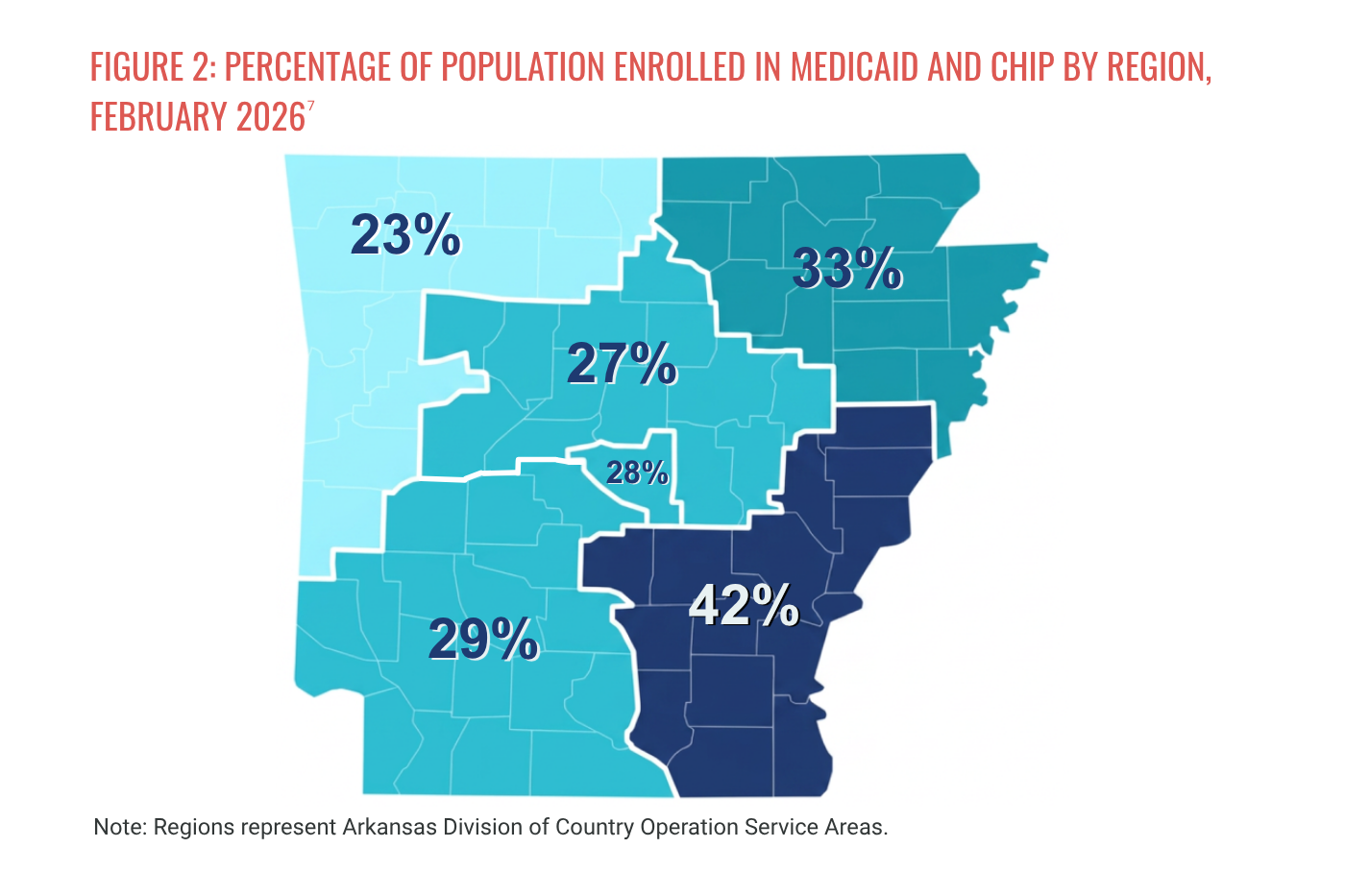
In 2018, Arkansas became the first state to implement Medicaid work requirements as a condition of eligiblity, though the requirements were shortly discontinued following a federal court decision. Figure 1 shows statewide trends in Arkansas Medicaid enrollment since 2018 for individuals enrolled in full-benefit plans. Figure 2 shows the percentage of Arkansans enrolled in Medicaid by region in February 2026.
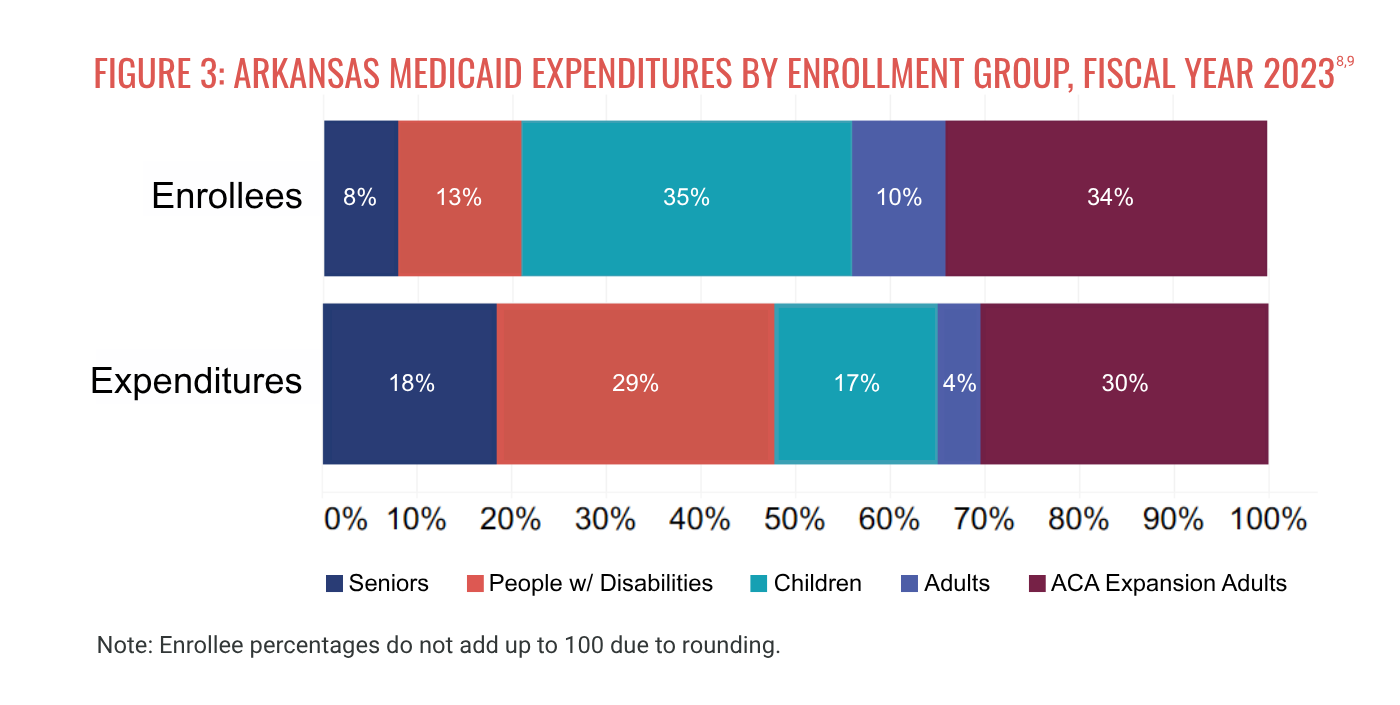
Medicaid spending varies considerably by enrollee age group. For example, although seniors represent a small percentage of overall enrollment in Medicaid (see Figure 3), expenditures per senior enrollee far exceed those of children. In 2023, the average annual cost of covering a senior enrollee was $12,816, compared to $2,864 for the average child, even though almost all senior Medicaid enrollees are also eligible for Medicare.8,9 The difference in average expenditures is largely due to long-term services and supports. Medicare covers only time-limited skilled nursing facility stays for rehabilitative purposes, whereas Medicaid covers long-term services and supports, including institutional care in a nursing facility and home- and community-based services that are designed to enable people to stay in their homes rather than moving to a facility for care.
Medicaid financing traditionally has been a shared responsibility between states and the federal government. For most Medicaid services, the federal share is based on the federal medical assistance percentage (FMAP), determined annually by the Department of Health and Human Services.10 A state’s FMAP rate is calculated based on a state’s average per capita income, with lower-income states receiving greater federal assistance. A state’s FMAP, or the percentage of Medicaid costs paid by the federal government, must be between 50% and 83%. For fiscal year 2027, state FMAPs range from 50% to 77%.11 During the COVID-19 pandemic, states received a temporary 6.2 percentage point FMAP increase.12 Arkansas’s average FMAP between fiscal years 2020 and 2023 was 77.6%, while its average FMAP between fiscal years 2024 and 2027 was 70.7%.11
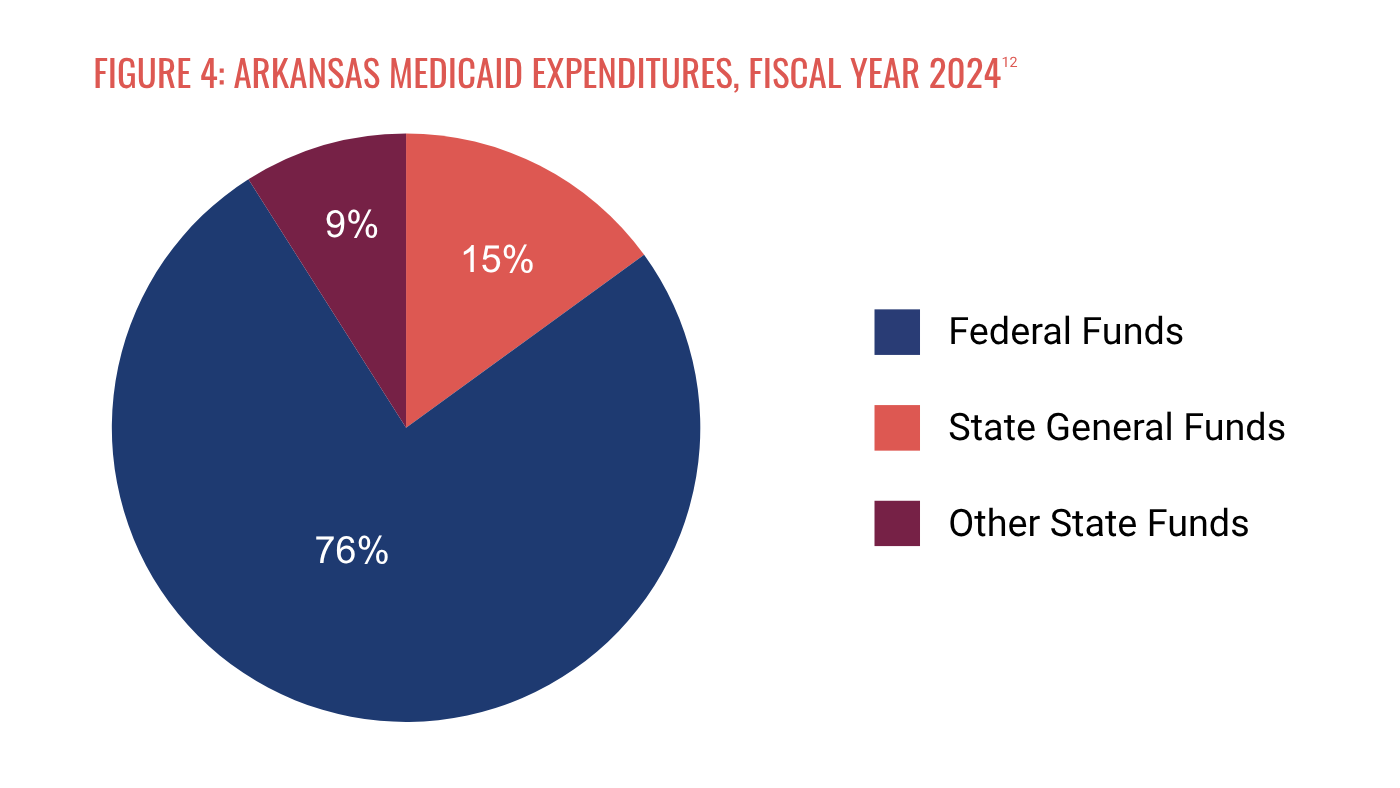
Arkansas funded nearly 25% of Medicaid program-related costs during the 2024 fiscal year, with the federal government providing the remaining funds (see Figure 4).12 State funding for Medicaid comes from appropriated general revenues, drug rebates, recovered funds, license fees, and the Medicaid Trust Fund.13
State Medicaid programs must cover the following mandatory benefits to receive federal matching funds:14
- Inpatient hospital services
- Outpatient hospital services
- Early and periodic screening, diagnostic, and treatment (EPSDT) services
- Nursing facility services
- Tobacco cessation counseling for pregnant women
- Physician services
- Rural health clinic services
- Home health services
- Laboratory and X-ray services
- Freestanding birth center services (when licensed or otherwise recognized by the state)
- Family planning services
- Nurse midwife services
- Transportation to medical care
- Certified pediatric and family nurse practitioner services
- Federally qualified health center services
- Medication-assisted treatment (MAT)
- Routine patient costs of items and services for beneficiaries enrolled in qualifying clinical trials
- Concurrent care for children while receiving hospice care
Along with mandated federal benefits, states can also provide optional benefits to their Medicaid populations. Optional services in Arkansas include prescription drug coverage and services that allow beneficiaries to receive care in home- or community-based settings.
The Patient Protection and Affordable Care Act of 2010 required states to expand Medicaid coverage to adults earning up to 138% of the federal poverty level, although a 2012 U.S. Supreme Court ruling made expansion optional. For states that chose to expand coverage, the federal government would cover 100% of expansion costs for the first three years of implementation, with the federal match later decreasing to 90%. In 2014, Arkansas implemented a unique version of Medicaid expansion through the Arkansas Health Care Independence Program, commonly known as the “private option.” Rather than covering newly eligible adults through traditional Medicaid, Arkansas used Medicaid funds through premium assistance to purchase qualified health plans offered through the Health Insurance Marketplace. This approach required a Section 1115 Medicaid demonstration waiver, a type of waiver that allows states to test care delivery and financing models that promote the goals of Medicaid.
Arkansas’s expansion program has continued under different names and is currently known as Arkansas Health and Opportunity for Me (ARHOME). As of February 2026, ARHOME reported 226,758 enrollees, making it the second-largest Medicaid eligibility group after ARKids A (307,292).7
The current ARHOME demonstration waiver is approved through December 31, 2026. In April 2026, the Arkansas Department of Human Services (DHS) applied to extend the ARHOME program waiver through 2031. The application proposed continuing ARHOME, implementing new work and community engagement requirements for certain enrollees, in alignment with requirements under the federal budget reconciliation law, H.R. 1, and expanding the Life360 HOMEs program.15,a In July 2026, CMS verbally informed Arkansas officials that the state’s five-year Medicaid expansion renewal request would not be approved.16 DHS officials have reported the request was denied because of new, stricter rules under H.R. 1 regarding budget neutrality, which requires that ARHOME not cost the federal government more than it would spend without the program.17,18
DHS has requested a two-year temporary extension of the waiver to allow the state time “to wind down the existing program while simultaneously designing and implementing a new Medicaid delivery system” as well as to transition beneficiaries from the existing program.17 If an extension is not granted, how the program will be administered is in question. However, DHS officials have indicated that beneficiaries will continue to receive some form of Medicaid coverage.19
States use a variety of delivery models to provide Medicaid services. In a fee-for-service (FFS) model, the state establishes a provider network and pays providers directly for covered services. In a managed care model, a state contracts with managed care organizations that receive a set per-member, per-month payment to arrange and pay for covered services.
Nationally, managed care is the dominant service delivery mechanism used by state Medicaid programs. As of July 2024, 41 states (including Arkansas) and the District of Columbia contracted with comprehensive, risk-based managed care plans to provide care to at least some of their Medicaid beneficiaries.20 Under Medicaid managed care, required Medicaid health benefits and any supplemental services are provided through contracted arrangements between state Medicaid agencies and managed care organizations (MCOs).
a Life360 HOMEs provides additional support to ARHOME enrollees in at-risk and/or underserved populations, including young adults at risk of poverty and poor health outcomes (Success Life360), pregnant women (Maternal Life360), and those living in low-access rural areas (Rural Life360).21 Arkansas’s ARHOME waiver renewal application proposed an expansion of Maternal Life360 provider eligibility in an effort to increase access to the program for mothers in “maternity care deserts,” i.e., areas without any hospitals or birth centers offering obstetric care and without any obstetric providers.15,22
Arkansas uses managed care more narrowly than many states. In fiscal year 2024, MCO spending accounted for 9% of total Arkansas Medicaid spending.23 This percentage reflects spending for two managed care programs, the Provider Led Arkansas Shared Savings Entity (PASSE) program, which serves Medicaid beneficiaries with complex behavioral health, developmental, or intellectual disabilities, and the Healthy Smiles program, which managed dental services until those services were moved to the FFS model on November 1, 2024.13 As of July 2026, the PASSE program is the only managed care program offered through Arkansas Medicaid.24,25 The PASSE program is managed through four different MCOs: Arkansas Total Care, CareSource, Empower Healthcare Solutions, and Summit Community Care.26
Under the PASSE program, Arkansas Medicaid pays approved provider-led entities a set per member per month payment to coordinate care and pay for covered services for enrolled beneficiaries.25 PASSEs assign each enrollee a care coordinator who serves as a liaison between the enrollee and the PASSE and works with the enrollee’s family and providers to develop a person-centered service plan that identifies preferences, goals, and choices.
The passage of the budget reconciliation law, H.R. 1, in 2025 resulted in many new financing and eligibility regulations for the Medicaid and CHIP programs. Many provisions will take effect in late 2026.
One of the broadest eligibility changes in H.R. 1 was the creation of the work and community engagement requirements. Medicaid expansion adults will be required to complete 80 hours a month of employment or community service, or be enrolled in an education program at least half-time (as determined by the institution).27,28 Exemptions exist for certain populations, including pregnant women, disabled veterans, and individuals who are “medically frail;” however, questions remain about how some exemptions, including the medically frail exemption, will be interpreted and implemented. States must implement these new regulations by January 1, 2027. Arkansas’s pending 1115 waiver application outlines the state’s plan for compliance with these new eligibility rules.15
Beginning January 1, 2027, H.R. 1 also requires states to conduct Medicaid eligibility renewals, also known as redeterminations, for Medicaid expansion adults every six months, rather than once every 12 months as under prior law.29 Other Medicaid eligibility groups will generally remain on a 12-month renewal cycle.
H.R. 1 eliminates Medicaid eligibility for some lawfully present immigrant groups, including refugees and trafficking survivors, while preserving eligibility for others.30 Beginning October 1, 2026, eligibility will be limited to lawful permanent residents, Cuban and Haitian entrants, lawfully residing children and pregnant women, and lawfully residing citizens of the Freely Associated States under the Compacts of Free Association (COFA), which include the Republic of the Marshall Islands, the Federated States of Micronesia, and the Republic of Palau. The COFA distinction is particularly relevant in Arkansas, which is home to the largest Marshallese population outside of the Marshall Islands.31
Medicaid financing reform has been a recurring topic at the federal level, with recent legislation and proposed rules focused on federal spending, eligibility, and state financing mechanisms such as provider taxes and state-directed payments (SDP).32,33 SDPs are payments for Medicaid managed care services made directly between the state Medicaid program and the service provider.
H.R. 1 includes several Medicaid financing provisions, including limits on SDP arrangements. For expansion states, certain SDP payment ceilings are limited to 100% of Medicare payment rates; for non-expansion states, the ceiling is 110% of Medicare payment rates.34 CMS has issued a proposed rule to implement these SDP limits. The proposal would eventually apply payment-rate limits to all SDPs and certain fee-for-service payments. Some existing or pending SDPs could be temporarily grandfathered, but those payments would be phased down over time.35 Arkansas will not be affected by this provision, as the state does not currently utilize SDPs.36
H.R. 1 also changes provider tax rules for expansion states. Provider taxes are taxes or fees imposed on healthcare providers, such as hospitals or nursing facilities.37 These taxes are used to support state financing for Medicaid programs as eligibility and provider reimbursement rates shift. Beginning October 1, 2028, the threshold for provider taxes imposed by expansion states will be lowered by half a percentage point every year until October 1, 2032, when the new tax threshold will equal 3.5%. Taxes on nursing facilities and intermediate care facilities are exempt from reduction if they are in effect by October 1, 2026, and do not exceed the previous 6% hold harmless threshold.34 In Arkansas, the ambulance tax is the only non-exempt tax above the 3.5% save harbor threshold.37
H.R. 1 will also reduce federal financing for Emergency Medicaid, a reimbursement program for emergency medical services provided to uninsured noncitizens who would be eligible for Medicaid but for their immigration status.38 Taking effect October 1, 2026, this provision will eliminate the 90% federal Medicaid match rate for states providing emergency care to noncitizens who would be eligible for Medicaid expansion coverage if not for their immigration status. Instead, states will receive their regular Medicaid match for those services.34
Medicaid is a healthcare safety net for some of Arkansas’s most vulnerable populations. Medicaid serves older adults, people with disabilities, children, pregnant women, and individuals for whom private healthcare coverage is financially out of reach. It is also a major state-federal financing structure that supports healthcare providers and services across the state.
Federal changes to Medicaid eligibility and financing could impact enrollment and program design in Arkansas. ACHI will continue to monitor healthcare coverage changes for Arkansans as implementation occurs.
1 Centers for Medicare and Medicaid Services. State Medicaid and CHIP applications, eligibility determinations, and enrollment data. Data.Medicaid.gov. Accessed June 19, 2026. https://data.medicaid.gov/dataset/6165f45b-ca93-5bb5-9d06-db29c692a360
2 Arkansas Department of Human Services. Frequently asked questions. Accessed August 5, 2026. https://humanservices.arkansas.gov/divisions-shared-services/medical-services/frequently-asked-questions/
3 Centers for Medicare and Medicaid Services. Medicaid eligibility. CMS.gov. Accessed July 16, 2026. https://www.cms.gov/files/document/slidesmedicaidandchiprenewals09272023.pdf
4 U.S. Centers for Medicare and Medicaid Services. Arkansas ARKids B Section 1115 Demonstration fact sheet. Accessed August 5, 2026. https://downloads.cms.gov/cmsgov/archived-downloads/MedicaidStWaivProgDemoPGI/downloads/Arkansas%20ARKidsB%20Fact%20Sheet.pdf
5 Part 608. ARKids First B provider manual. Code of Arkansas Rules. Accessed July 16, 2026. https://codeofarrules.arkansas.gov/Rules/Rule?levelType=part&titleID=20&chapterID=130&subChapterID=342&partID=1348
6 Rudowitz R, Artiga S, Arguello R. A look at Section 1115 Medicaid demonstration waivers under the ACA: a focus on childless adults. KFF. October 9, 2013. Accessed August 6, 2026. https://www.kff.org/medicaid/a-look-at-section-1115-medicaid-demonstration-waivers-under-the-aca-a-focus-on-childless-adults/
7 Snapshot: SNAP and Medicaid. Arkansas State Legislature. Accessed July 16, 2026. https://www.arkleg.state.ar.us/Home/FTPDocument?path=%2FAssembly%2FMeeting+Attachments%2F083%2F27902%2FExhibit+D-+SNAP+and+Medicaid+Data.pdf
8 Medicaid enrollees by enrollment group. KFF. Accessed July 16, 2026. https://www.kff.org/medicaid/state-indicator/distribution-of-medicaid-enrollees-by-enrollment-group/
9 Medicaid spending by enrollment group. KFF. Accessed July 16, 2026. https://www.kff.org/medicaid/state-indicator/medicaid-spending-by-enrollment-group/
10 Congressional Research Service. Medicaid’s Federal Medical Assistance Percentage (FMAP). April 2, 2025. Accessed July 31, 2026. https://www.congress.gov/crs_external_products/R/PDF/R43847/R43847.13.pdf
11 Federal Medical Assistance Percentage (FMAP) for Medicaid and multiplier. KFF. Accessed July 16, 2026. https://www.kff.org/medicaid/state-indicator/federal-matching-rate-and-multiplier/
12 National Association of State Budget Officers. 2025 state expenditure report: fiscal years 2023-2025. 2025. Accessed July 16, 2026. https://higherlogicdownload.s3.amazonaws.com/NASBO/9d2d2db1-c943-4f1b-b750-0fca152d64c2/UploadedImages/SER%20Archive/2025_SER/2025_NASBO_State_Expenditure_Report_S.pdf
13 Arkansas Department of Human Services. Medicaid overview booklet 2024. Accessed July 16, 2026. https://humanservices.arkansas.gov/wp-content/uploads/Medicaid_Program_Overview_SFY2024.pdf
14 Centers for Medicare and Medicaid Services. Mandatory & optional Medicaid benefits. Medicaid.gov. Accessed July 16, 2026. https://www.medicaid.gov/medicaid/benefits/mandatory-optional-medicaid-benefits
15 Arkansas Department of Human Services. ARHOME Section 1115 demonstration project application. April 30, 2026. Accessed August 24, 2026. https://www.medicaid.gov/medicaid/section-1115-demonstrations/downloads/ar-arhome-renewal-app-20260511.pdf
16 Ansell N. Arkansas’ request to extend Medicaid expansion program has been rejected, governor’s office confirms. Arkansas Democrat-Gazette. July 31, 2026. Accessed August 24, 2026. https://www.arkansasonline.com/news/2026/jul/31/arkansas-request-to-extend-medicaid-expansion/
17 Vrbin T. Arkansas seeks 2-year reprieve for state’s hybrid Medicaid expansion. Arkansas Advocate. August 6, 2026. Accessed August 19, 2026. https://arkansasadvocate.com/2026/08/06/arkansas-seeks-2-year-reprieve-for-states-hybrid-medicaid-expansion/
18 Centers for Medicare and Medicaid Services. CMS takes bold new approach to stewarding Medicaid demonstration project spending. News release. June 11, 2026. Accessed August 13, 2026. https://www.cms.gov/newsroom/press-releases/cms-takes-bold-new-approach-stewarding-medicaid-demonstration-project-spending
19 Vrbin T. Arkansas officials confident people on Medicaid expansion will retain health coverage. Arkansas Advocate. August 17, 2026. Accessed August 24, 2026. https://arkansasadvocate.com/2026/08/17/arkansas-officials-confident-people-on-medicaid-expansion-will-retain-health-coverage/
20 Total Medicaid MCOs. KFF. Accessed July 16, 2026. https://www.kff.org/medicaid/state-indicator/total-medicaid-mcos/
21 Life360. Arkansas Department of Human Services. Accessed July 16, 2026. https://humanservices.arkansas.gov/divisions-shared-services/medical-services/healthcare-programs/arhome/life360/
22 Health Resources and Services Administration. Exploring health center capacity in rural maternity care deserts: key takeaways/policy implications. Accessed August 5, 2026. https://bphc.hrsa.gov/sites/default/files/bphc/data-reporting/brief-1.pdf
23 Total Medicaid MCO spending. KFF. Accessed July 16, 2026. https://www.kff.org/medicaid/state-indicator/total-medicaid-mco-spending/
24 Information for beneficiaries. Arkansas Department of Human Services. Accessed July 16, 2026. https://humanservices.arkansas.gov/divisions-shared-services/medical-services/healthcare-programs/dental/dental-beneficiaries/
25 PASSE — Provider-Led Arkansas Shared Savings Entity. Arkansas Department of Human Services. Accessed July 16, 2026. https://humanservices.arkansas.gov/divisions-shared-services/medical-services/healthcare-programs/passe/
26 Medicaid MCO enrollment by plan and parent firm, 2024. KFF. Accessed July 16, 2026. https://www.kff.org/medicaid/state-indicator/medicaid-enrollment-by-mco/
27 Hinton E, Diana A, Rudowitz R. A closer look at the work requirement provisions in the 2025 Federal Budget Reconciliation Law. KFF. July 30, 2025. Accessed July 16, 2026. https://www.kff.org/medicaid/a-closer-look-at-the-work-requirement-provisions-in-the-2025-federal-budget-reconciliation-law/
28 U.S. Department of Education. Proposed regulatory language. Accessed July 31, 2026. https://www.ed.gov/media/document/gp-issues-2-cleanpdf-57218.pdf
29 Serafi K, Dervan E. New CMS guidance on six-month renewals in Medicaid. State Health and Value Strategies. March 12, 2026. Accessed September 9, 2026. https://shvs.org/resources/new-cms-guidance-on-six-month-renewals-in-medicaid/
30 Pillai D, Rao A, Artiga S. 1.4 million lawfully present immigrants are expected to lose health coverage due to the 2025 tax and budget law. KFF. September 25, 2025. Accessed July 16, 2026. https://www.kff.org/immigrant-health/1-4-million-lawfully-present-immigrants-are-expected-to-lose-health-coverage-due-to-the-2025-tax-and-budget-law/
31 Wargo J. The United States recognizes the Marshallese community, as Arkansas leads the way in cultural connections. East-West Center. October 25, 2019. Accessed August 17, 2026. https://asiamattersforamerica.org/articles/the-united-states-recognizes-the-marshallese-community-as-arkansas-leads-the-way-in-cultural-connections
32 President Donald J. Trump. Eliminating waste, fraud, and abuse in Medicaid. The White House. June 6, 2025. Accessed July 16, 2026. https://www.whitehouse.gov/presidential-actions/2025/06/eliminating-waste-fraud-and-abuse-in-medicaid/
33 Congressional Research Service. Health coverage provisions in One Big Beautiful Bill Act (H.R. 1). June 13, 2025. Accessed July 16, 2026. https://www.congress.gov/crs_external_products/R/PDF/R48569/R48569.1.pdf
34 American Medical Association. Summary: changes to Medicaid financing. September 9, 2025. Accessed July 16, 2026. https://www.ama-assn.org/system/files/medicaid-financing-changes-summary.pdf
35 Centers for Medicare and Medicaid Services. Medicaid program; Medicaid managed care state directed payments and Medicaid fee-for-service targeted Medicaid practitioner payments. Federal Register. May 22, 2026. Accessed July 16, 2026. https://www.federalregister.gov/documents/2026/05/22/2026-10292/medicaid-program-medicaid-managed-care-state-directed-payments-and-medicaid-fee-for-service-targeted
36 Centers for Medicare and Medicaid Services. Approved state directed payment preprints. Medicaid.gov. Accessed August 17, 2026. https://www.medicaid.gov/medicaid/managed-care/guidance/state-directed-payments/approved-state-directed-payment-preprints
37 Burns A, Hinton E, Raphael J, Rudowitz R. 5 questions and answers about Medicaid and provider taxes. KFF. August 20, 2026. Accessed August 20, 2026. https://www.kff.org/medicaid/5-key-facts-about-medicaid-and-provider-taxes/
38 Park JK, Reyes-Becerra C, Makhlouf MD. State flexibility in Emergency Medicaid to care for uninsured noncitizens. 2023;4(7):e231997. doi:10.1001/jamahealthforum.2023.1997