Rural communities continue to experience decreasing access to maternity care, both in Arkansas and across the country. A new report from the Center for Healthcare Quality and Payment Reform assessing maternal health care in rural communities reveals persistent challenges.
Fewer Arkansas Hospitals Offering Maternity Care
Nationally, the report finds that since the end of 2020, 133 rural hospitals have stopped delivering babies or announced they will stop before the end of 2026. In Arkansas, the report states that 27% of the labor and delivery units at rural hospitals have closed since 2020. Among those rural hospitals in Arkansas still operating labor and delivery units in 2026, 44% of the units are at risk of closing, according to Center for Healthcare Quality and Payment Reform.
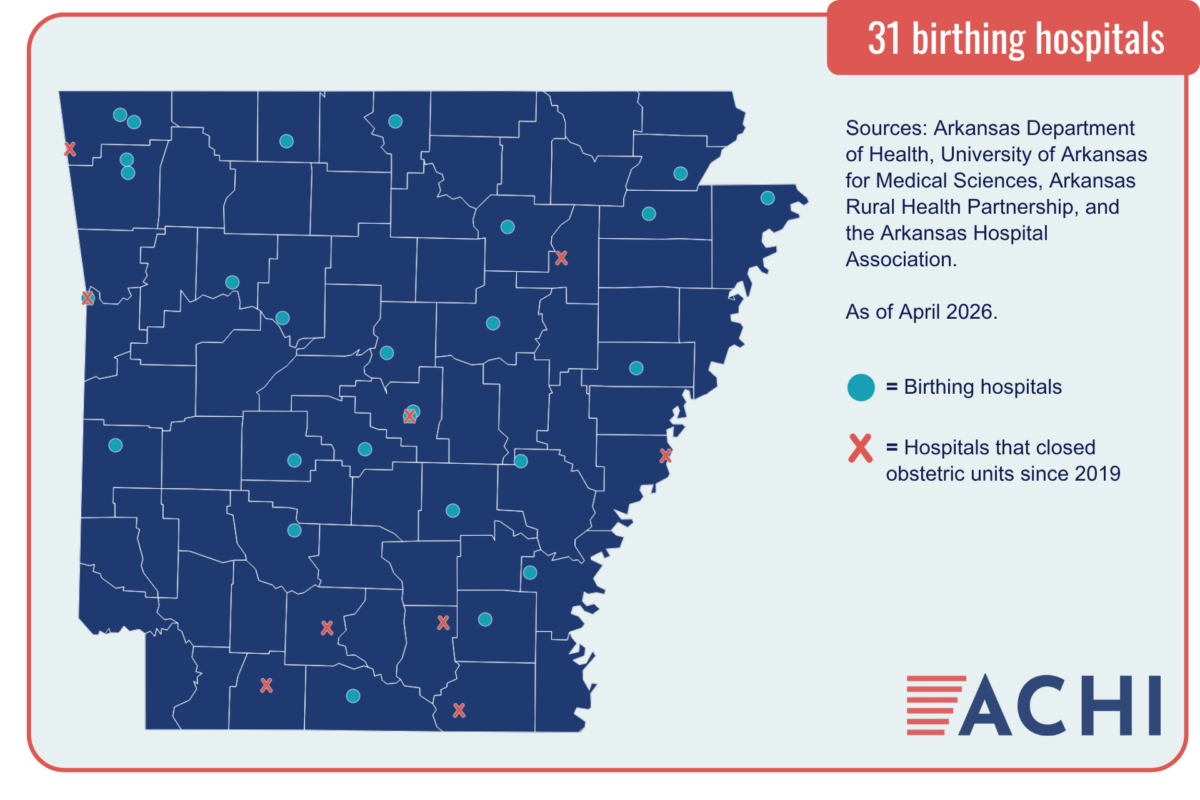
ACHI’s map of birthing hospitals (above) shows that only 31 hospitals in Arkansas continue to provide labor and delivery services. Since 2019, nine hospitals, including some in urban areas, have closed their obstetric units, four of them due to staffing shortages and five primarily due to financial considerations.
The most recent closures occurred at Ouachita County Medical Center in Camden, which ceased labor and delivery services in January 2026, and Baptist Health-Fort Smith, which ceased services in April 2026.These closures mean that women in only 22 of Arkansas’s 75 counties can receive obstetrical services at hospitals within their home counties.
Continued Financial Pressures on Rural Hospitals
The threat to rural maternity care is part of a broader financial crisis facing rural hospitals. Current challenges include rising staffing costs, outmigration of younger residents to more urban areas of the state, low birth volume, and low reimbursement rates for obstetrical care. Labor and delivery services can be challenging to sustain because rural hospitals must maintain staff and physicians capable of performing deliveries 24-7, which can be difficult and costly in rural areas where birth volumes are low.
A recent ACHI analysis found that Medicaid financed 47% of births statewide and that at the county level, the percentages of Medicaid-financed births ranged from a low of 29% in Benton County to a high of 79% in Hempstead County. Many counties with large portions of Medicaid-financed births are rural counties where lower birth volume and outmigration trends make maternity care difficult to sustain. While recent policy changes have significantly increased Medicaid reimbursement rates for obstetrical care, prior years of low reimbursement rates have impacted many facilities.
Statewide Efforts and Initiatives
Act 124 of 2025, the Healthy Moms, Healthy Babies Act, is a step toward increasing access to prenatal, labor and delivery, and postpartum care for Arkansas mothers. The act establishes presumptive Medicaid eligibility for pregnant women, allowing them to receive Medicaid benefits and initiate prenatal care while waiting for their Medicaid applications to be approved; establishes Medicaid coverage for pregnancy-related health monitoring; and unbundles Medicaid payments for pregnancy care, allowing providers to be paid separately for prenatal and postnatal care visits. Additional provisions establish Medicaid coverage for remote patient monitoring and for doula and community health worker services related to prenatal and postpartum care. A separate law, Act 627 of 2025, requires Medicaid coverage for breastfeeding and lactation consultant services. The public comment period closed in March for proposed Arkansas Medicaid rules that would implement certain provisions of Act 124 and related 2025 maternal health laws, and those rules are now moving through the state’s legislative review process for final approval.
Also, Arkansas has been selected for the Transforming Maternal Health (TMaH) model, a 10-year federal model that provides the state with up to $17 million to support improvements to maternal health care. TMaH, a whole-person approach to pregnancy, childbirth, and postpartum care, is aimed at reducing disparities in access and treatment, improving outcomes and experiences for mothers and newborns, and reducing overall expenditures. Current TMaH-supported efforts reported by the Arkansas Department of Human Services include the development of toolkits for doulas and midwives, training for doulas and perinatal community health workers, and technical assistance for telemedicine and remote patient monitoring.
Additional ACHI maternal health analyses and information are available on our Maternal and Infant Health topic page.