
Medicare Advantage plans offer an alternative way for those who are eligible for Medicare to receive healthcare benefits. Unlike traditional Medicare, which is directly administered by the federal government, Medicare Advantage plans are offered by private insurance companies under contract with Medicare. These plans provide the health services offered by traditional Medicare but may include additional benefits such as dental, vision, and hearing coverage; include integrated Medicare Part D prescription drug coverage; and include out-of-pocket spending caps, enhancing their appeal to beneficiaries. While the Medicare Advantage program may offer benefits not available through traditional Medicare, it also introduces plan-specific provider networks, more frequent use of prior authorization requirements, and complex benefits designs that beneficiaries must navigate. This explainer provides an overview of Medicare Advantage, examines recent enrollment trends in Arkansas, and discusses government oversight of the program.
Medicare is a federal program that was established in 1965 to provide healthcare coverage for people age 65 and older, originally encompassing Part A (hospital insurance) and Part B (medical insurance). Medicare Advantage (Part C) was established under a provision of the Balanced Budget Act of 1997 to provide additional choices for beneficiaries beyond the traditional Medicare program and incorporate the efficiencies and cost savings observed in private-sector managed care.1 See Figure 1 for a timeline of key legislation related to Medicare Advantage. Medicare Part D (prescription drug coverage) was established in 2003.
Medicare Advantage plans consolidate Medicare Part A and Part B, with 89% of plans in 2026 also including Part D prescription drug coverage.2 The plans cover all medically necessary services required by traditional Medicare, but with varying out-of-pocket costs and service rules, such as prior authorization requirements — in which insurance will only pay for a service if it was approved by the insurer prior to the service being rendered — for certain services or medications.3
For beneficiaries, benefits of Medicare Advantage include an out-of-pocket spending maximum, potentially lower cost sharing compared to traditional Medicare, the convenience of coordinated care, and often additional benefits such as dental, vision, and hearing coverage.4 In May 2026, 326,297 Arkansans were enrolled in Medicare Advantage plans.5
1965
SOCIAL SECURITY AMENDEMENTS OF 1965
Established Medicare Part A (hospital insurance) and Part B (medical insurance).
1972
SOCIAL SECURITY AMENDEMENTS OF 1972
Introduced managed care contracted on a capitated basis (i.e. the insurer is paid a fixed monthly amount per enrollee) to Medicare, a model that shifts risk onto the insurer. This set the stage for what would become Medicare Advantage.
1982
TAX EQUITY AND FISCAL RESPONSIBILITY ACT
Made managed care a formal component of Medicare. Final rules set payments to private plans below the average costs of traditional Medicare in their service areas, intending to encourage efficiency and cost savings.
1997
BALANCED BUDGET ACT
Created Medicare Part C (Medicare Advantage), reworking payment formulas and establishing new risk-adjustment measures.
2003
MEDICARE MODERNIZATION ACT
Increased plan capitation payments, modified risk adjustments, and created Medicare Part D, prescription drug coverage. Added regional preferred provider organizations and special needs plans to Part C.
2010
AFFORDABLE CARE ACT
Reduced Medicare Advantage payments to bring them closer to traditional Medicare levels and introduced quality-based payments, which reward insurers for high quality of service.
2018
BIPARTISAN BUDGET ACT
Allowed Medicare Advantage plans to offer targeted supplemental benefits, such as dental coverage, expanding types of benefits available to enrollees. Increased funding for these enhancements.
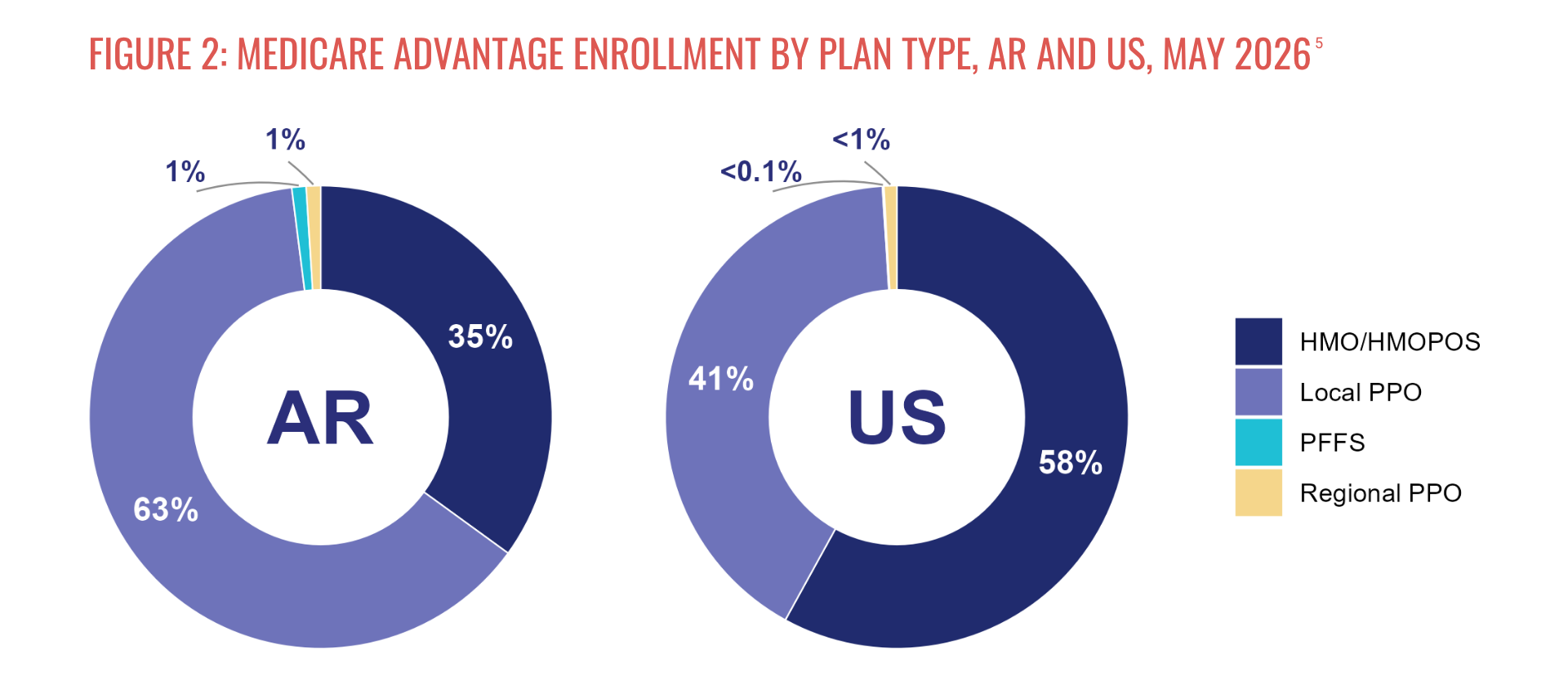
Like other private insurance plans, Medicare Advantage plans come in several forms, each with its unique structure and rules. Unlike traditional Medicare, which allows beneficiaries to choose any provider accepting Medicare, Medicare Advantage plans nearly always require enrollees to use a network of contracted providers, hospitals, pharmacies, and suppliers, which may restrict access to care, especially in rural areas.7 The primary differences between plan types involve out-of-network coverage, referral requirements, and how the networks are administered. A variety of Medicare Advantage plans are offered in Arkansas. Figure 2 compares the distribution of these plans in Arkansas and nationally, by plan type.
Types of Medicare Advantage plans include:
- Health Maintenance Organization (HMO): Among plan types, HMOs on average have the smallest and most geographically limited networks. HMOs generally offer very low cost sharing when care is received from an in-network provider but offer no benefits for care received out-of-network, except for emergency care, urgent care, out-of-area dialysis, maintenance and post-stabilization care, and ambulance services in some circumstances.8 These plans generally require a referral from a primary care provider for a specialist visit, to promote coordinated care. Because their networks are relatively small and care is coordinated by a primary care provider, HMOs tend to offer lower premiums and cost sharing than other plan types. Some insurers offer HMO point-of-Service (HMOPOS) plans, which offer partial benefits for certain out-of-network care. As of May 2026, 113,836 Arkansans were in an HMO or HMOPOS.5
- Preferred Provider Organization (PPO): A PPO, like an HMO, pays for care through a network of contracted providers, and enrollees pay less for care received from in-network (“preferred”) providers. Unlike an HMO, a PPO will pay a partial benefit for care received out-of-network and generally does not require a referral from a primary care provider for a specialist visit. There are two types of PPO plans within Medicare Advantage: local and regional.9 A local PPO serves a small area, such as a single county or a group of counties selected by the plan and approved by Medicare. Local PPOs tend to have lower premiums and cost sharing, and they are relatively common, with 206,815 enrollees in Arkansas in May 2026.5 A regional PPO is designed to serve a large area, encompassing an entire state or multiple states. Regional PPOs generally have higher premiums and cost sharing, and account for a much smaller share of Arkansas enrollment, with 3,276 enrollees in May 2026.
- Private Fee-for-Service (PFFS) Plan: PFFS plans set how much they pay for medical services and what the enrollee pays out-of-pocket.10 Unlike PPOs and other network-based plans, enrollees may see any Medicare-approved provider; however, the provider must agree to the plan’s payment terms separately for each service rendered. Many PFFS plans have networks of providers that agree in advance to accept the plan’s terms. An out-of-network provider may decide whether to accept the plan’s terms for a service but generally is not required to provide non-emergency care if the terms are not accepted. Cost sharing may be higher for out-of-network care. Regardless of network status, PFFS plans may allow providers to charge up to 15% more than the amount the plan pays, leaving the enrollee responsible for the difference. PFFS plans are uncommon, with only 2,370 enrollees in Arkansas in May 2026.5
- Special Needs Plan (SNP): SNPs are Medicare Advantage plans available to individuals with specific diseases or eligibility characteristics, offering specialized care for those needs. SNPs are generally structured as HMOs or PPOs, and their enrollment is included in the numbers reported above. All SNPs must provide Part D coverage. There are three primary types of SNPs: 11
- Dual Special Needs Plan (D-SNP): Designed for individuals who are eligible for both Medicaid and Medicare, D-SNPs coordinate the benefits of both across the two programs. There were 80,643 D-SNP enrollees in Arkansas in May 2026.
- Chronic Condition Special Needs Plan (C-SNP): C-SNPs are plans with networks and benefits specially designed to facilitate treatment of specific chronic diseases. There were 46,916 C-SNP enrolleesa in Arkansas in May 2026.
- Institutional Special Needs Plan (I-SNP): I-SNPs are plans limited to certain individuals needing long-term care in a nursing facility, those who are confined to an intermediate care or inpatient psychiatric facility, and those who are determined to need an institutional level of care but are not yet residents of a facility. There were 2,704 I-SNP enrollees in Arkansas in May 2026.
- Medicare Medical Savings Account (MSA) Plans: An MSA plan combines a Medicare Advantage high-deductible health plan with a medical savings account. An MSA plan deposits funds into a savings account, which the enrollee can use to pay for healthcare expenses, with certain tax advantages. These plans do not offer prescription coverage. Wisconsin is the only state with an MSA plan available to its residents.12
To be eligible for Medicare Advantage, individuals must first be enrolled in Medicare Part A and Part B. Once eligible, individuals can enroll in Medicare Advantage or change their Medicare Advantage plans during the following designated enrollment periods:6
- Initial Enrollment Period: Upon first becoming eligible for Medicare, a person can join a Medicare Advantage plan during an initial enrollment period. This seven-month window begins three months before a person’s 65th birthday, includes the person’s birth month, and extends through the three months following the person’s birth month. A person must be enrolled in both Medicare Part A and Part B to join a Medicare Advantage plan.
- Open Enrollment Period: Occurring from October 15 to December 7 each year, this period provides the opportunity for existing Medicare beneficiaries to switch to a Medicare Advantage plan, change their current plan, or revert to traditional Medicare.
- Medicare Advantage Open Enrollment Period: From January 1 to March 31 annually, a person enrolled in a Medicare Advantage plan has the option to switch to a different Medicare Advantage plan (with or without drug coverage) or drop the Medicare Advantage plan and switch back to traditional Medicare, with the opportunity to join a separate Medicare drug plan. During this period, a person with traditional Medicare cannot switch to a Medicare Advantage plan, join a Medicare drug plan, or switch from one Medicare drug plan to another.
- Special Enrollment Periods: These periods allow beneficiaries to make changes to their plans outside of the open enrollment periods due to specific life events, such as relocating to a new area or losing existing coverage.
As more Arkansans opt for Medicare Advantage (see below), they can access resources such as the Seniors Health Insurance Information Program, which provides free Medicare counseling to help navigate the program.13 Beneficiaries are encouraged to utilize online resources, such as Medicare’s official tool for comparing and selecting plans, available at Medicare.gov/plan-compare, to find the plan that aligns best with their healthcare needs and financial situation.14
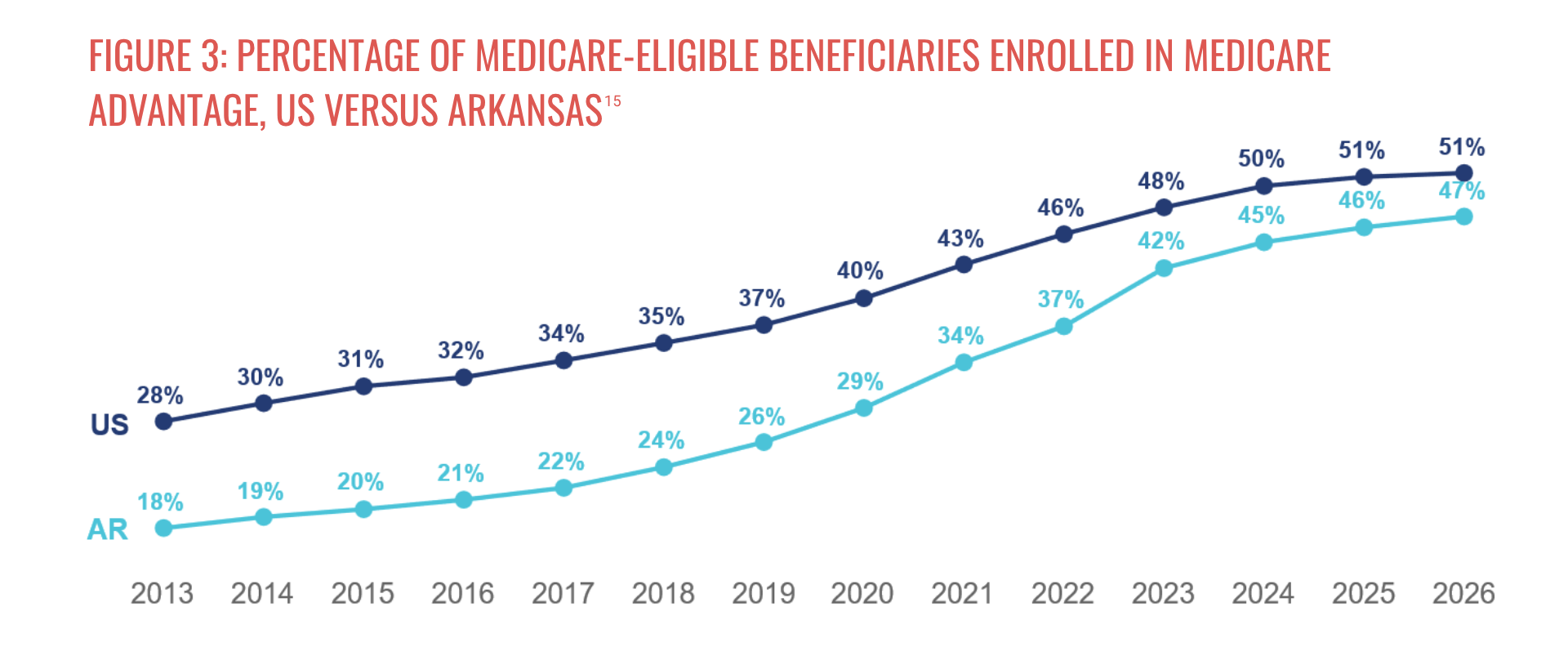
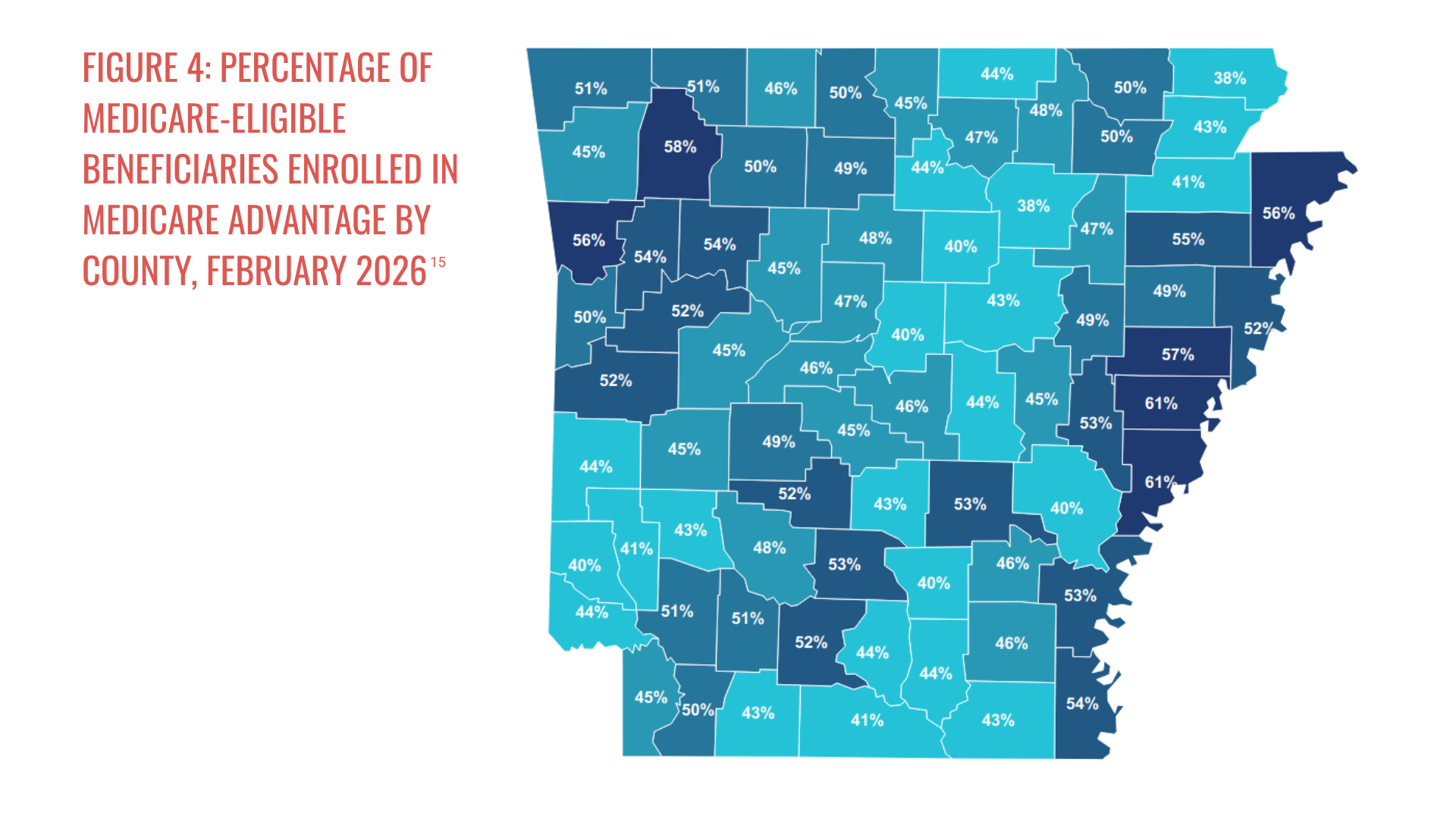
Medicare Advantage plans have seen steady increases in enrollment over the past decade. As of 2026, about 47% of the Medicare-eligible population in Arkansas was enrolled in Medicare Advantage plans.15 Figure 3 shows a consistent upward trend in Medicare Advantage enrollment from 2013 through 2026. Figure 4 provides a county-by-county breakdown of enrollment as of February 2026, showing variations across the state, with some counties seeing over half of eligible beneficiaries opting for Medicare Advantage plans.
The Medicare Advantage market in Arkansas reflects a growing but not yet dominant preference for these plans over traditional Medicare. Advertising and the perceived value of the plans are key drivers of their growing popularity. While these promotions can increase awareness, they can also sometimes lead to confusion among seniors regarding their options.16 Federal rulemaking addressing marketing practices in recent years has gone back and forth between regulating and deregulating Medicare Advantage plan marketing (see the Marketing Practices section below).
Medicare pays Medicare Advantage plans a prospective monthly payment per enrollee, called a capitation. Each year, the Centers for Medicare and Medicaid Services (CMS) calculates a county-specific benchmark based largely on projected traditional Medicare spending in a given county. The benchmark is set between 95% and 115% of the projected per capita traditional Medicare spending in that county, with the percentage depending on how the projected spending compares to that of other counties. Counties with lower Medicare spending receive a higher benchmark. The benchmark serves as the maximum base capitation that Medicare will pay for an enrollee in that county.17
Plans that demonstrate high quality of care, as indicated by the CMS five-star quality rating system (see below), may receive a 5% increase in their benchmark through the Medicare quality bonus program. Because benchmarks are based on traditional Medicare spending, some counties with particularly low traditional Medicare spending but high Medicare Advantage enrollment have their quality increase doubled to 10%, to offset the low baseline benchmark. The program is intended to incentivize insurers to improve the quality of service their plans provide by giving them additional payments that they may use to offer additional benefits or reduce cost sharing for enrollees.18
Insurers submit bids for each of their Medicare Advantage plans estimating the per-enrollee cost of providing Medicare Part A and Part B benefits.19 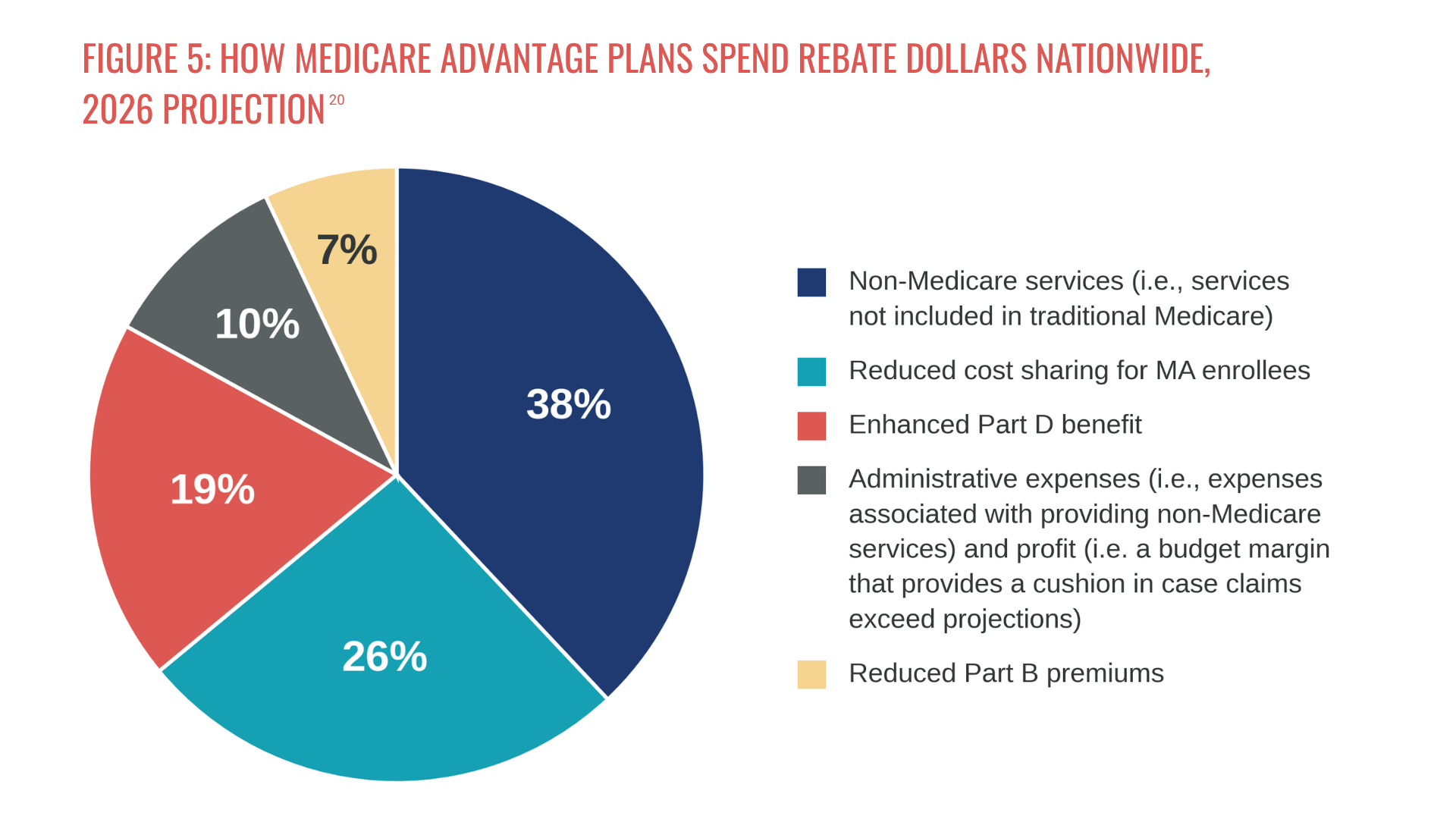 When a plan’s bid comes in above the benchmark, the difference is charged to the plan’s enrollees as a monthly premium. When a plan’s bid comes in below the benchmark, the insurer receives a rebate equal to a percentage of the difference between the bid and the benchmark. This percentage is determined by the plan’s reported quality star rating: 50% for plans rated below 3.5 stars, 65% for plans rated at least 3.5 stars but less than 4.5 stars, and 70% for those rated 4.5 stars or higher.21 These rebates must be used to benefit enrollees either by enhancing plan benefits or reducing their out-of-pocket costs.19 Administrative expenses and a small profit margin, to provide a cushion in case claims exceed projections, are allowable components of the projected cost of providing enhanced plan benefits. Figure 5 shows a projected breakdown of how rebate dollars will be spent through 2026.
The government also provides regulatory oversight of Medicare Advantage plans to ensure that enrollees are protected and that plans adhere to established standards. Key aspects of this oversight include:
- Marketing Practices: Marketing of Medicare Advantage plans has come under scrutiny for practices that can mislead consumers, particularly older adults and those with disabilities.22 In 2024, CMS finalized a rule to combat these issues; however, the only provision that survived subsequent litigation is one prohibiting marketing organizations from sharing beneficiaries’ contact information without express written consent. This was intended to address complaints about harassing solicitations. CMS finalized a rule in 2026 which reversed course, eliminating several consumer protections such as waiting periods between educational events and plan marketing, various required disclaimers, and a prohibition on unsupported superlatives in marketing material.23
- Capitation Rates: CMS announces changes to methodologies used to calculate capitations annually in an annual “Rate Announcement.” The 2027 Rate Announcement indicated an overall increase in payments to Medicare Advantage plans of 2.48%, effective in 2027.24 This is higher than the 0.09% rate increase projected in an Advance Notice which preceded the 2027 Rate Announcement.25
- Network Requirements: Medicare Advantage organizations offering coordinated care plans and other network-based plans are required to maintain a network of healthcare providers that is sufficient to offer covered services that meet the needs of the population served.26 This means the network must include an adequate number of primary care providers, specialists, hospitals, and other healthcare facilities to ensure enrollees can access care without unreasonable delay.27
- Prior Authorization: Prior authorization requirements are more common in Medicare Advantage plans than in traditional Medicare.28 Medicare Advantage plans must adhere to traditional Medicare coverage policies when reviewing requests for services and must make coverage criteria publicly acessible. Approved prior authorizations are valid for the entire course of treatment.29 In 2025, CMS secured an industry pledge — from insurance companies covering nearly 80% of Americans — to reduce the volume of services subject to prior authorization, implment real-time approvals for most requests, and increase transparency surrounding decisions and appeals, among prior authorization reforms.30
- Quality and Performance Standards: CMS evaluates Medicare Advantage plans using a range of quality and performance measures, which are reflected in the CMS five-star quality rating system.31 The star ratings are publicly reported to help beneficiaries make informed decisions when choosing a plan. The criteria and methodology for calculating star ratings are updated regularly. A 2027 CMS rule, issued in 2026, intended to streamline the star rating system eliminated 11 quality and performance measures, including measures of member complaint volume, claims denials and appeals processes, and customer service.32
- Transparency and Reporting: Medicare Advantage organizations are required to report certain information to CMS, including details on plan benefits, network adequacy, and payments.33 In January 2024, CMS issued a rule requiring insurers to publicly report certain prior authorization metrics.34 An April 2024 rule included several transparency provisions, notably including a requirement for plans to send a mid-year notice to enrollees notifying them of unused supplemental benefits.35 Subsequent rules rescinded that requirement and relaxed network adequacy and medical loss ratio reporting requirements.36,37 Some transparency provisions have been retained, including expanded enrollee appeal rights and a requirement that insurers make coverage criteria publicly accessible.
- Expansion of Behavioral Health Access: Some regulatory updates in recent years have sought to improve access to behavioral health services. Beginning in 2024, Medicare Advantage plans were required to include clinical psychologists and clinical social workers in network adequacy evaluations.38 CMS later added an outpatient behavioral health category that includes marriage and family therapists, mental health counselors, addiction medicine clinicians, opioid treatment providers, and other practitioners who provide psychotherapy or treatment for substance use disorders.35
- Dual Special Needs Lookalike Plans: D-SNPs are required to contract with state Medicaid programs, but states are not required to accept D-SNP contracts, giving states substantial authority to set the terms under which D-SNPs operate. Regular Medicare Advantage plans do not need state approval, leading some insurers to seek access to the dual-eligible market on their own terms by designing Medicare Advantage plans to resemble D-SNPs, then marketing the resulting “look-alike” plans to dual-eligible Medicare beneficiaries.39 To address this practice, CMS issued a rule in 2020 stipulating that Medicare would not approve contracts for regular Medicare Advantage plans in which over 80% of enrollees are dually eligible.40 A 2024 rule reduced this threshold to 70% in 2025 and 60% in 2026.35 A 2026 rule indicated that D-SNP lookalikes have grown increasingly common among C-SNPs and I-SNPs, which are not subject to the same threshold, but did not take any immediate regulatory action.36
- Expanded Audits: CMS performs Risk Adjustment Data Validation (RADV) audits to catch and recover overpayments made to Medicare Advantage plans, such as when diagnoses associated with claims are not supported by medical records. In 2025, CMS announced plans to address an audit backlog and implement annual audits for all Medicare Advantage plans, using additional staff and integration of artificial intelligence tools in audit procedures.41 Part of the motivation behind this move was a 2023 rule that allowed CMS to extrapolate findings from a sample of audited records across a plan’s contract, increasing potential recoveries.42 This rule was vacated by a federal court order in late 2025.43 The decision limits CMS’ ability to recover overpayments through that extrapolation methodology, but it did not eliminate RADV audits or CMS’ authority to recover unsupported payments identified through audits.
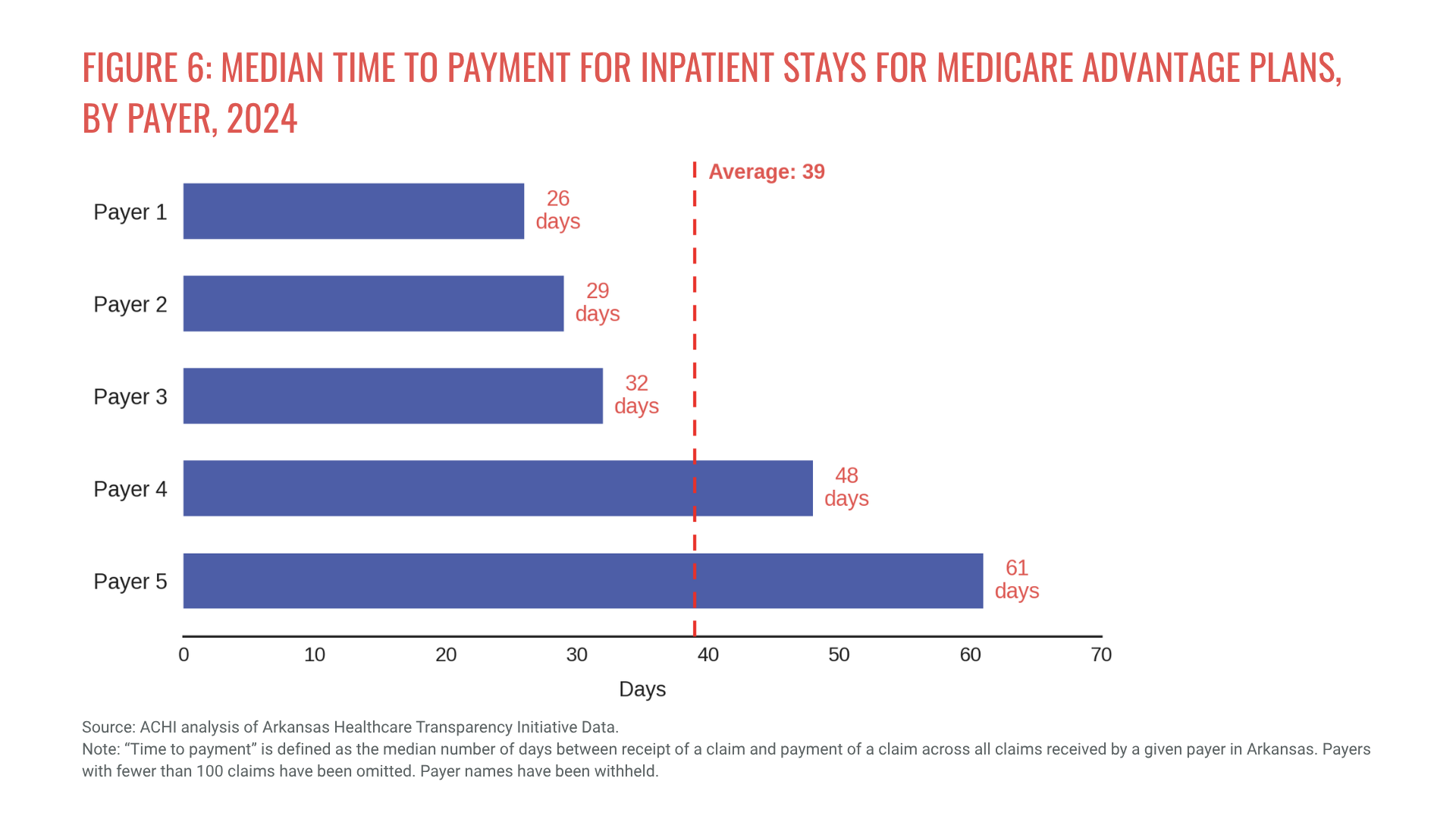
Providers have raised concerns about Medicare Advantage plans, particularly regarding delays in approval for care or provider payments due to prior authorization policies. Providers have also complained of a general lack of transparency about payment methods and coverage decisions.44 In Arkansas, the average median time for Medicare Advantage plans to provide payment for inpatient stays in 2024 was 39 days across all payers, according to an analysis by the Arkansas Center for Health Improvement. By payer, median payment times in 2024 ranged from 26 days to 61 days (see Figure 6).
 These issues adversely impact patient care and the financial stability of healthcare practices, and they have led to a growing dissatisfaction among hospitals and health systems, with some opting to terminate their contracts with certain Medicare Advantage plans due to unsustainable financial losses and excessive administrative burdens.45 Ongoing monitoring is important to ensure that Medicare Advantage plans adhere to federal requirements and effectively meet the needs of both providers and beneficiaries.
Between 2019 and 2026, enrollment in Medicare Advantage plans by Medicare beneficiaries in rural areas increased from 24.6% to 47.2%.46 This shift has implications for critical access hospitals — isolated rural hospitals specially designated by Medicare to receive reimbursements based on the cost of services rather than prospective rates. Unlike traditional Medicare, Medicare Advantage plans often provide reimbursement for these hospitals through negotiated rates that may differ from cost-based reimbursements. These differences may create financial pressure for rural hospitals, especially in states without Medicaid expansion.47
Another concern is the coverage of services that are essential for the financial stability of rural hospitals. In Medicare Advantage plans, benefits, choice of facility, costs, and coverage may differ from traditional Medicare and may not be aligned with services such as swing beds, which are hospital beds that can be used for either acute care or skilled nursing care, giving rural hospitals needed flexibility. The ongoing financial and administrative challenges associated with Medicare Advantage plans have driven a substantial number of rural hospitals nationwide to drop contracts with Medicare Advantage providers, with some hospital leaders specifically highlighting prior authorization and claims denials as primary factors in decisions to walk away from the program.48 Despite recent efforts to address administrative issues, especially regarding prior authorization decisions, issues remain in aligning Medicare Advantage payments with traditional Medicare’s cost-based reimbursements for hospitals and improving transparency to help hospitals better understand beneficiaries’ healthcare needs and negotiate rates.
As Medicare Advantage has grown, researchers have examined how it compares with traditional Medicare in federal and beneficiary spending, access to services, and enrollee satisfaction. Findings have been mixed and often contradictory.
The Medicare Payment Advisory Commission (MedPAC) has estimated that Medicare will spend $76 billion, or 14%, more for Medicare Advantage enrollees in 2026 than it would have spent had those enrollees been in traditional Medicare instead.20 Medicare Advantage proponents dispute MedPAC’s methodology and argue that the additional spending provides coverage that ultimately reduces costs for beneficiaries.49 Research surrounding beneficiary spending is mixed, with some studies showing lower out-of-pocket costs for Medicare Advantage enrollees compared to traditional Medicare enrollees, while others have found little difference or higher costs for some Medicare Advantage enrollees.50,51 Despite the cost differences, research tends to find little difference in enrollee satisfaction or outcomes between the two programs.52 Research on comparative access to healthcare services is also mixed; Medicare Advantage enrollees generally have far fewer physician choices, but enrollees of both programs report similar wait times and difficulty accessing care.
Because of the lack of decisive research findings, it is difficult to appraise the value and effectiveness of Medicare Advantage relative to traditional Medicare.
Medicare Advantage extends the range of benefits and plan design options available to Medicare beneficiaries, but it also introduces limitations, such as more narrow provider networks and more frequent prior authorization requirements. Medicare Advantage enrollment has consistently grown over the past decade both nationwide and in Arkansas, where nearly half of the state’s Medicare beneficiaries opted for Medicare Advantage in 2026. If the growth of Medicare Advantage continues, industry trends and frequent federal regulatory changes will impact an increasingly large share of Arkansans. Understanding the complexities of Medicare Advantage will only grow more important for healthcare stakeholders and policymakers both in Arkansas and nationwide.
a Two of the plans available in Arkansas were regional Arkansas-Missouri PPOs, so this figure likely includes some Missouri enrollees. These plans together only had 2,618 enrollees, so the overcount is likely minimal.
1 McGuire TG, Newhouse JP, Sinaiko AD. An economic history of Medicare Part C. Milbank Q. 2011;89(2):289-332. doi:10.1111/j.1468-0009.2011.00629.x
2 Freed M, Ochieng N, Biniek JF, Damico A, Neuman T. Medicare Advantage 2026 spotlight: a first look at plan premiums and benefits. KFF. December 9, 2025. Accessed August 20, 2026. https://www.kff.org/medicare/medicare-advantage-2026-spotlight-a-first-look-at-plan-premiums-and-benefits/
3 Medicare Rights Center. Medicare Advantage 101: Medicare Advantage history: legislative milestones. 2023. Accessed August 17, 2026. https://www.Medicarerights.org/pdf/Medicare-advantage-101-legislative-milestones.pdf
4 Ramsay C, Jacobson G, Findlay S, Cicchiello A. Medicare Advantage: a policy primer. The Commonwealth Fund. January 31, 2024. Accessed July 23, 2026. https://www.commonwealthfund.org/publications/explainer/2024/jan/medicare-advantage-policy-primer
5 Centers for Medicare and Medicaid Services. MA Enrollment by SCP 2026 05. CMS.gov. Accessed August 24, 2026. https://www.cms.gov/data-research/statistics-trends-and-reports/medicare-advantagepart-d-contract-and-enrollment-data/monthly-ma-enrollment-state/county/plan-type/ma-enrollment-scp-2026-05
6 Centers for Medicare and Medicaid Services. Understanding Medicare Advantage plans. Medicare.gov. April 2026. Accessed August 17, 2026. https://www.Medicare.gov/publications/12026-understanding-Medicare-advantage-plans.pdf
7 Biniek JF, Clerveau G, Damico A, Neuman T. Medicare Advantage enrollment, plan availability and premiums in rural areas. KFF. September 7, 2023. Accessed July 23, 2026. https://www.kff.org/Medicare/Medicare-advantage-enrollment-plan-availability-and-premiums-in-rural-areas/
8 General Requirements, 42 C.F.R. § 422.100 (2026). Accessed August 20, 2026. Code of Federal Regulations. https://www.ecfr.gov/current/title-42/chapter-IV/subchapter-B/part-422/subpart-C/section-422.100
9 Freed M, Biniek FJ, Damico A, Neuman T. Medicare Advantage in 2026: premiums, out-of-pocket limits, supplemental benefits, and prior authorization. June 5, 2026. Accessed July 23, 2026. https://www.kff.org/Medicare/Medicare-advantage-in-2026-premiums-out-of-pocket-limits-supplemental-benefits-and-prior-authorization/
10 Centers for Medicare and Medicaid Services. Private fee-for-service (PFFS) plans. Medicare.gov. Accessed July 23, 2026. https://www.Medicare.gov/health-drug-plans/health-plans/your-health-plan-options/PFFS
11 Centers for Medicare and Medicaid Services. SNP comprehensive report 2026 05. CMS.gov. Accessed July 23, 2026. https://www.cms.gov/data-research/statistics-trends-and-reports/Medicare-advantagepart-d-contract-and-enrollment-data/special-needs-plan-snp-data/snp-comprehensive-report-2026-05
12 Medicare Advantage plans, by plan type. KFF. Accessed July 23, 2026. https://www.kff.org/Medicare/state-indicator/plans-by-plan-type/
13 SHIIP. Arkansas Insurance Department. Accessed July 23, 2026. https://insurance.arkansas.gov/consumer-assistance/Medicare-resources/shiip/
14 Centers for Medicare and Medicaid Services. Find the plan that works for you. Medicare.gov. Accessed July 23, 2026. https://www.Medicare.gov/plan-compare/
15 Centers for Medicare and Medicaid Services. Medicare enrollment dashboard. Data.CMS.gov. July 23, 2026. Accessed July 23, 2026. https://data.cms.gov/tools/Medicare-enrollment-dashboard
16 Findlay S, Jacobson G, Leonard F. The role of marketing in Medicare beneficiaries’ coverage choices. The Commonwealth Fund. January 5, 2023. Accessed July 23, 2026. https://www.commonwealthfund.org/publications/explainer/2023/jan/role-marketing-Medicare-beneficiaries-coverage-choices
17 Ramsay C, Jacobson G. How the government updates payment rates for Medicare Advantage plans. The Commonwealth Fund. March 4, 2024. Accessed July 23, 2026. https://www.commonwealthfund.org/publications/explainer/2024/mar/how-government-updates-payment-rates-Medicare-advantage-plans
18 Xu L, Welch WP, Ruhter J, et al. Medicare Advantage overview: a primer on enrollment and spending. Office of the Assistant Secretary for Planning and Evaluation. May 2023. Accessed August 18, 2026. https://www.ncbi.nlm.nih.gov/books/NBK604796/
19 Centers for Medicare and Medicaid Services. Report to Congress: risk adjustment in Medicare Advantage. CMS.gov. December 2021. Accessed August 18, 2026. https://www.cms.gov/files/document/report-congress-risk-adjustment-medicare-advantage-december-2021.pdf
20 MedPAC. The Medicare Advantage program: status report. March 2026. Accessed August 18, 2026. https://www.medpac.gov/wp-content/uploads/2026/03/Mar26_Ch12_MedPAC_Report_To_Congress_SEC.pdf
21 Seshamani M, Lazio JW. Advance notice of methodological changes for calendar year (CY) 2025 for Medicare Advantage (MA) capitation rates and Part C and Part D payment policies. CMS.gov. January 31, 2024. Accessed August 18, 2026. https://www.cms.gov/files/document/2025-advance-notice.pdf
22 U.S. Senate Committee on Finance. Deceptive marketing practices flourish in Medicare Advantage. Accessed August 18, 2026. https://www.finance.senate.gov/imo/media/doc/Deceptive%20Marketing%20Practices%20Flourish%20in%20Medicare%20Advantage.pdf
23 Part 422 — Medicare Advantage program. Code of Federal Regulations. August 14, 2026. Accessed August 18, 2026. https://www.ecfr.gov/current/title-42/chapter-IV/subchapter-B/part-422
24 Centers for Medicare and Medicaid Services. 2027 Medicare Advantage and Part D rate announcement. CMS.gov. April 6, 2026. Accessed July 23, 2026. https://www.cms.gov/newsroom/fact-sheets/2027-Medicare-advantage-part-d-rate-announcement
25 Centers for Medicare and Medicaid services. 2027 Medicare Advantage and Part D advance notice. CMS.gov. January 26, 2026. Accessed July 23, 2026. https://www.cms.gov/newsroom/fact-sheets/2027-Medicare-advantage-part-d-advance-notice
26 Centers for Medicare and Medicaid Services. Network adequacy. CMS.gov. September 10, 2024. Accessed July 23, 2026. https://www.cms.gov/Medicare/health-drug-plans/network-adequacy
27 American Hospital Association. CMS finalizes CY 2024 Medicare Advantage rule. April 7, 2023. Accessed August 20, 2026. https://www.aha.org/system/files/media/file/2023/04/cover-cms-finalizes-cy-2024-medicare-advantage-rule-bulletin-4-7-2023.pdf
28 Biniek FJ, Sroczynski N, Freed M, Neuman T. Medicare Advantage insurers made nearly 53 million prior authorization determinations in 2024. January 28, 2026. Accessed July 23, 2026. https://www.kff.org/Medicare/Medicare-advantage-insurers-made-nearly-53-million-prior-authorization-determinations-in-2024/
29 Centers for Medicare and Medicaid Services. Medicare program; contract year 2024 policy and technical changes to the Medicare Advantage program, Medicare Prescription Drug Benefit Program, Medicare Cost Plan Program, and programs of all-inclusive care for the elderly. April 12, 2023. Accessed August 19, 2026. https://www.federalregister.gov/documents/2023/04/12/2023-07115/Medicare-program-contract-year-2024-policy-and-technical-changes-to-the-Medicare-advantage-program
30 U.S. Department of Health and Human Services. HHS Secretary Kennedy, CMS Administrator Oz secure industry pledge to fix broken prior authorization system. News Release. June 23, 2025. Accessed July 23, 2026. https://www.hhs.gov/press-room/kennedy-oz-cms-secure-healthcare-industry-pledge-to-fix-prior-authorization-system.html
31 Centers for Medicare and Medicaid Services. Medicare 2024 Part C & D star ratings: technical notes. CMS.gov. March 13, 2024. Accessed August 19, 2026. https://www.cms.gov/files/document/2024-star-ratings-technical-notes.pdf
32 Reynolds LC, Parkin LE, Bender DA, Loughran MK. CMS makes structural changes to star ratings system for Medicare Advantage and Part D plans. April 15, 2026. Accessed July 23, 2026. https://www.reedsmith.com/our-insights/blogs/health-industry-washington-watch/102mpnj/cms-makes-structural-changes-to-star-ratings-system-for-Medicare-advantage-and-pa/
33 Centers for Medicare and Medicaid Services. Medicare Part C reporting requirements. CMS.gov. Accessed August 20, 2026. https://www.cms.gov/files/document/cy2024-part-c-reporting-requirements.pdf
34 Centers for Medicare and Medicaid Services. Medicare program; request for information on Medicare Advantage data. Federal Register. January 30, 2024. Accessed August 20, 2026. https://www.federalregister.gov/documents/2024/01/30/2024-01832/Medicare-program-request-for-information-on-Medicare-advantage-data
35 Centers for Medicare and Medicaid Services. Contract year 2025 Medicare Advantage and Part D final rule (CMS-4205-F). CMS.gov. April 4, 2024. Accessed July 23, 2026. https://www.cms.gov/newsroom/fact-sheets/contract-year-2025-Medicare-advantage-part-d-final-rule-cms-4205-f
36 Centers for Medicare and Medicaid Services. Contract year 2027 Medicare Advantage and Part D final rule CMS.gov. April 2, 2026. Accessed July 23, 2026. https://www.cms.gov/newsroom/fact-sheets/contract-year-2027-Medicare-advantage-part-d-final-rule
37 Centers for Medicare and Medicaid Services. Contract year 2026 policy and technical changes to the Medicare Advantage program, Medicare Prescription Drug Benefit Program, Medicare Cost Plan Program, and programs of all-inclusive care for the elderly (CMS-4208-F). CMS.gov. April 4, 2025. Accessed July 23, 2026. https://www.cms.gov/newsroom/fact-sheets/contract-year-2026-policy-and-technical-changes-Medicare-advantage-program-Medicare-prescription-final
38 Centers for Medicare and Medicaid Services. 2024 Medicare Advantage and Part D final rule (CMS-4201-F). April 5, 2023. Accessed July 23, 2026. https://www.cms.gov/newsroom/fact-sheets/2024-Medicare-advantage-part-d-final-rule-cms-4201-f
39 Centers for Medicare and Medicaid Services. Medicare program; contract year 2021 policy and technical changes to the Medicare Advantage program, Medicare Prescription Drug Benefit Program, and Medicare Cost Plan Program. Federal Register. June 2, 2020. Accessed August 20, 2026. https://www.federalregister.gov/documents/2020/06/02/2020-11342/medicare-program-contract-year-2021-policy-and-technical-changes-to-the-medicare-advantage-program
40 Centers for Medicare and Medicaid Services. Contract year 2021 Medicare Advantage and Part D final rule (CMS-4190-F1) fact sheet. CMS.gov. May 22, 2020. Accessed July 23, 2026. https://www.cms.gov/newsroom/fact-sheets/contract-year-2021-Medicare-advantage-part-d-final-rule-cms-4190-f1-fact-sheet
41 Centers for Medicare and Medicaid Services. CMS rolls out aggressive strategy to enhance and accelerate Medicare Advantage audits. News release. May 21, 2025. Accessed July 23, 2026. https://www.cms.gov/newsroom/press-releases/cms-rolls-out-aggressive-strategy-enhance-accelerate-Medicare-advantage-audits
42 Centers for Medicare and Medicaid Services. Medicare and Medicaid programs; policy and technical changes to the Medicare Advantage, Medicare Prescription Drug Benefit, Program of All-Inclusive Care for the Elderly (PACE), Medicaid fee-for-service, and Medicaid managed care programs for years 2020 and 2021. Federal Register. February 1, 2023. Accessed August 20, 2026. https://www.federalregister.gov/documents/2023/02/01/2023-01942/Medicare-and-Medicaid-programs-policy-and-technical-changes-to-the-Medicare-advantage-Medicare
43 Court rules that CMS cannot extrapolate Medicare Advantage risk adjustment audit results. Groom Law Group. October 8, 2025. Accessed July 23, 2026. https://www.groom.com/resources/court-rules-that-cms-cannot-extrapolate-Medicare-advantage-risk-adjustment-audit-results/
44 Thompson AB. AHA urges MedPAC to examine Medicare Advantage denials, hospital market basket. American Hospital Association. November 30, 2023. Accessed July 23, 2026. https://www.aha.org/lettercomment/2023-11-30-aha-urges-medpac-examine-Medicare-advantage-denials-hospital-market-basket
45 Emerson J. Hospitals are dropping Medicare Advantage plans left and right. Becker’s Hospital Review. September 27, 2023. Accessed July 23, 2026. https://www.beckershospitalreview.com/finance/hospitals-are-dropping-Medicare-advantage-left-and-right/
46 Centers for Medicare and Medicaid Services. Medicare monthly enrollment. July 23, 2026. Accessed August 20, 2026. https://data.cms.gov/summary-statistics-on-beneficiary-enrollment/medicare-and-medicaid-reports/medicare-monthly-enrollment
47 Topchik M, Brown T, Pinette M, Balfour B, Wiesse A. Unrelenting pressure pushes rural safety net into uncharted territory. Chartis. February 13, 2024. Accessed July 23, 2026. https://www.chartis.com/insights/unrelenting-pressure-pushes-rural-safety-net-uncharted-territory
48 Jaffe S. When hospitals ditch Medicare Advantage plans, thousands of members get to leave, too. KFF Health News. April 28, 2025. Accessed July 23, 2026. https://kffhealthnews.org/health-care-costs/hospitals-abandon-Medicare-advantage-plans-members-quit-too/
49 Making policy based on flawed extrapolations could put seniors’ Medicare at risk. AHIP. June 17, 2026. Accessed July 23, 2026. https://www.ahip.org/news/articles/making-policy-based-on-flawed-extrapolations-could-put-seniors-Medicare-at-risk
50 Ippolito B, Trish E, Vabson B. Expected out-of-pocket costs: comparing Medicare Advantage with fee-for-service Medicare. Health Affairs. 2024;43(11):1502-1507. doi:10.1377/hlthaff.2024.00295
51 KFF. A review of 62 studies finds few big differences between traditional Medicare and Medicare Advantage on a variety of measures. News release. September 16, 2022. Accessed July 23, 2026. https://www.kff.org/Medicare/a-review-of-62-studies-finds-few-big-differences-between-traditional-Medicare-and-Medicare-advantage-on-a-variety-of-measures/
52 Jacobson G, Cicchiello A, Sutton JP, Shah A. Medicare Advantage vs. traditional Medicare: how do beneficiaries’ characteristics and experiences differ? The Commonwealth Fund. October 14, 2021. Accessed July 23, 2026. https://www.commonwealthfund.org/publications/issue-briefs/2021/oct/Medicare-advantage-vs-traditional-Medicare-beneficiaries-differ
Jennifer Wessel, JD, MPH, is ACHI’s director of health policy and data privacy officer.
Chris Ray is a health policy analyst at ACHI.